Showing posts with label Ancient Civilisations of the Inner Sea. Show all posts

Saturday, 19 October 2019

The Antics Roadshow

On Friday night Ancient Civilisations of the Inner Sea was back on the table, with the previous combatants - Adam, Andrew, Ian and myself (Sam) - this time joined by Chris. Adam was Mauritania, Ian Troy, Chris Rome and I was Egypt. Andrew remained the Gaul.

Chris had come early for a quick précis of the rules, but having done a bit of research already, he was pretty much up to speed when he arrived. The overhead is low on this one. And as the others trooped in and cracked open beers - Ian had a coffee - we were away with the briefest of catch-ups.


ACIS all happens through card-play, and it doesn't really do much in the way of increments: after everyone has deployed discs, it's a case of playing cards until everyone's noses are bloodied. Chris kicked off Epoch One, Turn One with a Bumper Crop. He gained talents for his harvest and added discs to Rome's nascent empire. I was next with Navigator, allowing me to cross the deep seas in order to stare longingly at the shores of the Mediterranean.  Ian uncovered a Gold Mine which added discs to Troy and got him talents. Adam's Academy of Science was not discarded but sat in front of him, allowing him more cards in the future. Andrew noted that his Improved Plough seemed evolutionarily some way behind an academy of sceince, but it rewarded him with more map presence and some cash.

So far, so cagey. I noted our opening was remarkably peaceful and Ian recalled that the last game started that way too. Besides - we had more cards to play. But with Chris now back at the wheel he built a Wonder - The Grand Temple, which assists in combat by (seemingly) spawning extra warriors and allies to your cause. It's the only war-specific temple and he beat me to it - instead I built the Grand Gardens, which allow me to add more discs to the map at the start of a turn. Ian played The Golden Age and was rewarded with discs and talents, Adam invented Coinage and Andrew built the Stairway to God, which - I think - added more cards to his hand. A flurry of map-movement followed with Trading House, Religious Fervor and Silk Road all getting played before Adam built his own wonder - the Great Pyramid. As I was Egypt, I was slightly offended. But there was no time to dwell on the narrative idosyncrasies, because Andrew passed and Chris played Sea Pirates, adding the first Barbarians (black discs) to the board. At this point they were merely lurking around menacingly though, and there was no hint of the fire of death that was to come at the end of this turn.


At this point everyone had passed and there were no competitions to be resolved. Minimal points were scored, with Ian slightly trailing. But when we drew fresh cards, the world exploded: we pulled no less than five of the seven events from a massive deck of cards, and Ian - as player last on VP - got to assign Barbarians in the north, south, across the Mesopotamian Empire and throughout the sea. We all - bar Ian himself - suffered the consequences. Suddenly Turn 2 was looking a lot more barbaric, and Andrew kicked things off with Blasphemy as he fought them out of his home territories. Adam and I did similarly whilst Chris busied himself opening a Sea Route to Britain and Ian took advantage of our distractions to gather a lot of cash. Andrew stole cards with his Spy, Adam and I gathered coins, Chris built the Great Library and Ian the Mausoleum. A flurry of discs came and left the board as we strengthened where we could and ejected Barbarians. Chris played a series of destructive cards causing havoc: Millennial Volcanoes, Massive Volcanoes, and finally Millennial Earthquakes that raged through the Iberian peninsula and ruptured Adam, Ian and Andrew's civilisations. I escaped his censure, but then I was busy fending off massive stacks of black discs at my end of the board.

Then, the Epoch suddenly ended! Ian rocketed up the track by 11 points, I clung on far enough to be five points behind him whilst the other three were another four or so points back. And so began our campaign to get Ian, although it was a somewhat muddy campaign as Ian campaigned against me as his nearest competitor, and the others weren't above chipping in to that effect either. When I tried to invent the Improved Plough (Epoch 2, turn 1) Andrew Negated me - the first negate action of the game, and all I was doing was planting some crops!

Chris and Andrew both went after Ian with Biblical Floods and Massive Earthquakes, whereas Adam stuck to the comparatively dainty Local Plague. Chris also made my crops fail, whereas Civil Disorder worked out okay for Ian, as he removed 4 opposition discs from the map and replaced them with Barbarians. Again, he scored reasonably well, and held the lead.


Turn 2 began with the return of Millennial Volcanoes (me) Negated by Adam. Chris then played the absolutely horrid Bread and Circuses, where my notes simply say 'tonnes of shit on Adam'. Andrew played the Black Death and Adam dug a Gold Mine, possibly to hide in. Chris and I both went after Ian with Widespread Plague and Civil War, and Ian ended the round still in the lead despite being hit by Barbarians.

Turn 3, Epoch two. Literally all of us went after Ian with our opening gambits, to the point where Ian protested that now I was going to win - as if that was a bad thing. Adam hit him with Gods Demand Sacrifice - and with no Negate, Ian had now lost two cards (one to me through the somewhat erroneously-named Trade, another to Adam's demands) He retorted by hitting the man in second place (me) with Millennial Earthquakes, probably scuppering any chance I had of a big score this turn. Chris passed early, and Andrew stared at the board before announcing "I'm in last, and everything's wank". He made someone's crops fail - I can't remember whose.


Ian played Local Plague - possibly at me, notes are a bit hazy now - before everyone but Andrew passed. He improved his plough and added Pirate Raids, before passing and everyone resolving competitions. The Sudden Death step saw the second Epoch also end suddenly - and with it, the game! In scoring I dropped to fifth - Ian scored very little, but clung onto a tiny lead as the others hurtled up the track to catch us both - but! There was a twist in the tail, however - the End of Epoch event penalised everyone for their cities - a point apiece! - suddenly all Adam, Chris and Andrew's scoring was reversed as they fell back down the track, as Ian and I as the comparatively low-scorers weren't so effected. Ian's lead was back to convincing, and final scoring (most cities/wonders/sea areas) was minimal enough to make no difference.
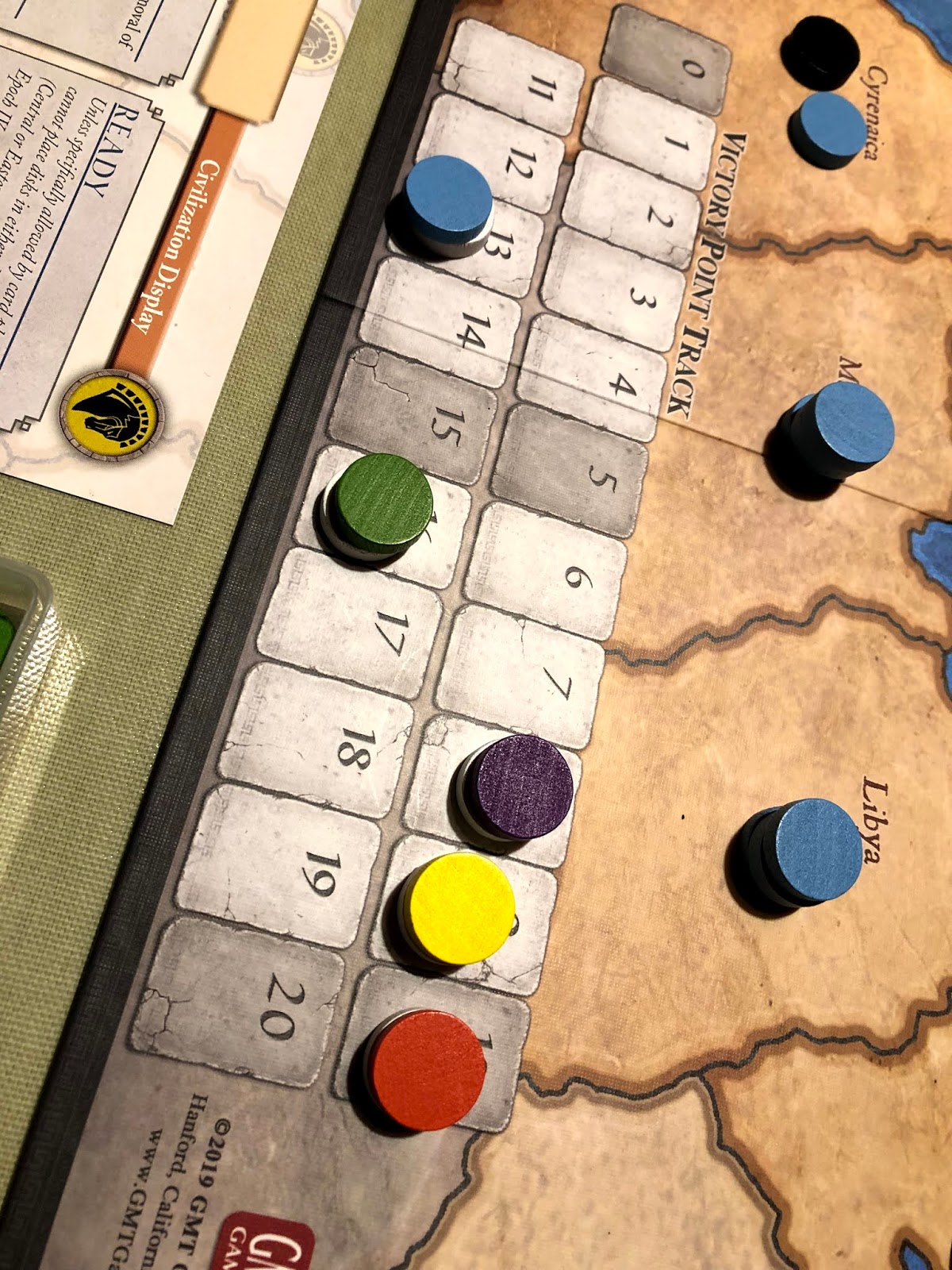
Final scores

Ian 36
Sam 33
Chris 30
Adam 29
Andrew 28

Our three and a half hour epic had come to a conclusion! And that was with only two epochs, both ending early. As we noted, it's best played at a clip (there's not a whole lot of logic to strategising too much, considering how swingy it all is) and we mostly did that, meaning despite the playtime the game felt relatively breezy. It is the type of game where the final placings can come down to the final event - as it did here - but we all sat down kinda knowing that. I'm looking forward to playing again, but I think two epochs is definitely enough - four would take all day!

Sunday, 29 September 2019

Troy Tempest

On a day when the BBC put an article entitled “Board Games: why are they becoming so popular?” four GNN regulars met up for a first attempt at Ancient Civilisations of the Inner Sea. In the BBC video, not one of the reasons given was that people wanted to be dicks to each other while playing a game of indeterminate but considerable length. But that’s why we were sat around Sam’s kitchen table.

Ancient Civilisations of the Inner Sea is set at the dawn of the Bronze Age around the Mediterranean Sea as each player adopts the role of a local aspiring empire. In our game, Sam was Troy, Adam was Egypt, Ian was Carthage and I was Gaul. It superficially resembled Time Of Crisis and I swiftly expanded into Rome almost out of habit. Sadly it wasn’t a game-winning move.


Adam, though, sprang into an early lead, building cities and using cards to put him onto four points, to Sam’s three and Ian and I sharing one. (Or should that be sharing two, since we had one each?) Sam sent Civil War into Egypt, removing five of Adam’s discs. Adam just drank slowly from his beer while regarding Sam coldly.


Why are board games so popular? Hmm. Good question.

Soon after this point there was an event entitled Breath of God which saw everybody instantly discard their hands and draw four new cards. Cue a chorus of grumbles at the unfairness of it all. Ian seemed to make the most of the new opportunities as he built loads of cities: so many that our attempts at stopping him were largely fruitless. He picked up ten points that round, jumping into first.

He retained his estate of ten cities for a while until Adam played the Bread & Circuses card which meant that the player with the most cities had to lose that many VPs, or pay for them with money or cards from his hand. That knocked six points of his tally. Finally the first epoch ended and it was 9.30. We’d been playing for two and a half hours! A full game lasts four epochs.


Epoch Two began with a general agreement that this could be the last. But before too long another event, Time Marches On, brought the epoch to an abrupt end. The score at this point was Adam 34, Sam 34, Ian 31, Andrew 27.

Adam was the main target of our ire, as we set about dismantiling his Egyptian/Palestinian empire. But we always had an eye on each other, as I sent barbarians into Sam’s lands and tried to stop Ian’s expansion into southern Spain.


Being in last, I was mostly unhindered by my opponents but the game itself still managed to get in my way. The event Resistance To Chance cost me three points for most cities just as I was about to score big.

Then, wouldn’t you know it, Time Marches On made another appearance. Epoch Three came to a sudden end and, with that, so did the game. It was 10.50, so we didn’t feel like risking a fourth epoch.


Sam 42
Adam 41
Ian 40
Andrew 37

While it had been long, it had never been boring with a remarkable lack of downtime between turns. There’s always something to watch and something to react to. It was fun, but the fact that there’s no real way to guess how long a game will be makes it an “event” game rather than one that’ll make an appearance at the weekly meet. Ian also noted that the name itself - Ancient Civilisations on the Inner Sea - was slightly too long. Sam promised to bring it to Novocon.

Then Adam decided it was time to go, but was persuaded to stay for one more by the wall of rain outside. We played Yokai. It was a breeze after the hardships of ACIS. And we did very well, hitting Legendary on the score track thing.


And then we set off, into the rain. Thanks for the evening.

Wednesday, 25 September 2019

Ancient, but Not Necessarily Justified

The Mediterranean. A hotbed of civilisation squabbling, technological advancements and expansioneering. I could be describing ancient history, or any number of board games from the past 20 years, but it so happens this is Ancient Civilisations of the Inner Sea. That somewhat unwieldy title - and the box - makes it sound very dry and very heavy, but although ACIS is a wargame - a GMT wargame at that - the heaviest thing about it is your sighs when some Trojan mo'fo sends another batch of Barbarians your way.


The game plays up to six but is apparently best with four, for reasons of duration if nothing else. With four epochs to play through - each consisting of four turns, each turn a series of cards from every player - the game is long, although you can agree to play three or even just two epochs: plenty will happen in that time.

Everything occurs on a map. Depending on player count, some areas will be inaccessible, and yesterday that was half the board as I played the Trojans (green) against the Egyptians (purple). Set-up is simple: plonk some discs on your home turf: one disc is some nomads, two stacked are a settlement, three or four represent a city. Nomads from different civilisations can co-exist peacefully, but anything above a single disc in an area with your opponents also present triggers a competition.

But Competition is phase 3, and before that comes Growth Phase and Card Phase.

Growth is simple. For every settlement you have on the board and every set of two shallow seas you occupy, you get to add an extra disc to the board - either building up your existing presence or spreading out from it across the map. Each civ also has it's own little specialism that may come into play here: if Egypt has a city on the Nile, for instance, they gain additional discs and money (talents).

The Card Phase is simple too. But it's also brutal. Almost every card played has some kind of negative impact, some of them critical. Volcanoes for instant can obliterate the heart of a civilisation and The Breath of God (an Event: events are always played the instant they are revealed) screws everyone's plans up in a big way. To say it's swingy and chaotic is an understatement - it makes Battle for Rokugan seem like a gentle Euro. Four things help balance out the big hits however. One is the existence of Negate cards, that can cancel out another card's effect. Beware though - negate cards can be negated themselves, and a card used to negate a negate can itself be negated... and so on. And in a large deck of cards, they don't crop up as often as you might like.


Another is the Events, which often (not always!) give the player with the fewest points an opportunity to screw over the civilisation/s furthest ahead of them - usually by sending Barbarians their way. Third is the fact you can, instead of removing discs when instructed to by a shitty card, pay talents or discard cards instead - but this can be risky, as both can be helpful when we reach the competition phase later. The main thing though is the ebb and flow of power across the region - the classic get-the-leader of wargaming. This can happen not only from epoch to epoch and turn to turn, but even card to card. The ideal strategy is to somehow sit just behind the leader for the duration and never make yourself too much a target, but this isn't easy - when the leader takes a big hit (and they will!) you would be the new target.

Instead of playing a card on your turn, you can build one of the seven Wonders instead. These give your civilisation an ongoing benefit (unless someone buries them, to use the game's parlance) and also score you a point per round. But they are costly: you need to pay at least two discs from the map plus any three combinations of more discs/cards from hand/talents.

Investment cards are one of the few non-violent cards, 
functioning like mini-Wonders.

Once everyone has passed (you can play Negate cards after passing) the Competition phase arrives, which is the resolution of contested areas. There's no dice rolling: instead discs get removed in ascending order of stacks: first the nomads, then the settlements, then the three-stack cities, then the four-stack cities. This is repeated until there is either a single faction left, or only nomads. But of course you can - as you would in the card phase - choose to pay talents or discard cards instead. And some cards are specifically Competition cards that can help you out in a specific fight, or even all fights this turn.

If you manage to wipe out an opponent's city and gain/keep control of an area, you also get to Loot: taking a talent and a victory point to recognise and reward your wrath.


Finally there is Reckoning phase, where some discs may be removed if someone dominates areas of the sea (ie controls all adjacent land areas) everyone scores points for cities and unburied (and occupied) wonders, turn order is decided (most cities first) and new cards are drawn for the next round.

There are a few wrinkles - epoch scoring, sudden death step (the epoch may end suddenly!) and the possibility of a struggling player to explode the board somewhat by going rogue with the Aeneas Step during epochs 1, 2 or 3. If you're wiped off the map or at least 5points behind everyone else, you can invoke this rule (once per game) and give yourself something of a boost, introducing up to 16 new discs to the map either as your existing civilisation or a new one. It sounds a lot, but as you have 50 at your disposal in entirety, and most may be in play at this point, it's not actually a move you'd seek to use as a planned strategy.

Yesterday I played Troy (green) versus Egypt (purple), and Troy began strongly. Not only did they start well, they accelerated into a lead of over ten points. I was concerned at this point that Troy were simply drawing the more fortuitous cards, and once a lead was established it would - in a two player game, at least - simply be built on. However thanks to the Events Egypt was able to rally, as Barbarians attacked from the east and the north (and the less helpful south, but never mind) burying Troy's wonder and halting their advances south as Egypt counter-attacked. Troy's focus on expansion meant they had a huge presence on the board, but Egypt now had more cities and were scoring more points. The Egyptians raced in a strong lead and held it - with the downside being that they now bore the brunt of Events themselves. But owing to fortune, less events were appearing, and Troy had to change tactics. Once Egypt deployed heavily in the north-east corner of the map, Troy ceded the region and sailed south to the Nile, attacking Egypt's three cities and attempting to wipe out the Wonder there.

Endgame. Troy have decimated Egypt.

Egypt used most of its cards to defend the wonder and the city, in the end keeping the wonder intact but losing it as both sides fought over it for most of the final turn of the final epoch. In hindsight, Egypt might have been better to let that one go and attack Troy elsewhere - the vast spread of green settlements had been turned into cities, and in the final count-up Troy galloped over the line to claim a resurgent win, 60-58.

It's kinda nuts. BGG criticism essentially all says the same thing - that the game has no arc; that each civilisation has no opportunity to build infrastructure or the kind of advancements that allow for a more strategic overall approach. It is a reasonable observation, but my impression is this isn't an oversight: the designers have made ACIS very deliberately bunfighty and swingy, asking the players to police each other and the resultant pretty mess representing the ebb and flow of empires building and crumbling over the years. I would agree that kind of chaotic fight is probably better with a shorter game than ACIS's three-plus hours, but my game yesterday lasted two and I enjoyed every minute.