
Since it was a nice warm evening, we decided that today would be our only chance to play outside. We began with W1815, a game that recreates the Battle of Waterloo in fifteen minutes. Technology, eh?

This is a war game based mostly on the roll of a dice, although there are limited ways to offset losses if you’re British. It’s very historical, with the names of various generals (including Reille, as immortalized in the blog post above) and certain real events portrayed in the game, like Ney's Cavalry Charge. When this is triggered, a red mist descends upon one of your generals and the only move you can make is for him to keep charging until he dies or rolls a 1 or a 2. At this point, he calms down so you can do other things.
We played it twice, taking turns to be the French/British. And both times the British won! However, Joe’s victory was more overwhelming than mine and he was the overall winner 39-32 or something.
After this, we played Cities. A kind of mini-Carcassone, where meeples score for their areas and surroundings. These areas are built up using a Take It Easy style one person draws tiles at random and the other takes the same tile from their stack.

It was quick and easy and very easy to pick up. I enjoyed it for the short time it lasted, but I didn't win. I didn't keep a note of the scores. Somehow, playing games under the gaze of the moon meant that winning or losing didn't seem important.

Next up was Aton. This was my first game, but the rules were easy enough to understand. I couldn't withstand the onslaught from Joe's experience mind, though. We played twice: the first time was closer, and the second time was something of a rout.
By now it was 9.30, and it was cold enough for us to decide to go indoors. Now we had a larger table and still a couple of hours, we went for something a bit more meaty: Sekigahara, the unification of Japan. Joe assured me that the rules were simple enough, though as ten o'clock ticked past, I started to get a bit nervous. They're simple enough once you get going, but there are lots of exceptions.
Basically, you have armies of various clans, but when it comes to battle, you cannot use them unless you play a card with the same symbol on it. Additionally, your opponent may play a loyalty card – nothing to do with supermarkets, but a test to see if that army really is loyal to your cause. When this happens you have to play another card with that symbol on it, or watch it defect to the other side.
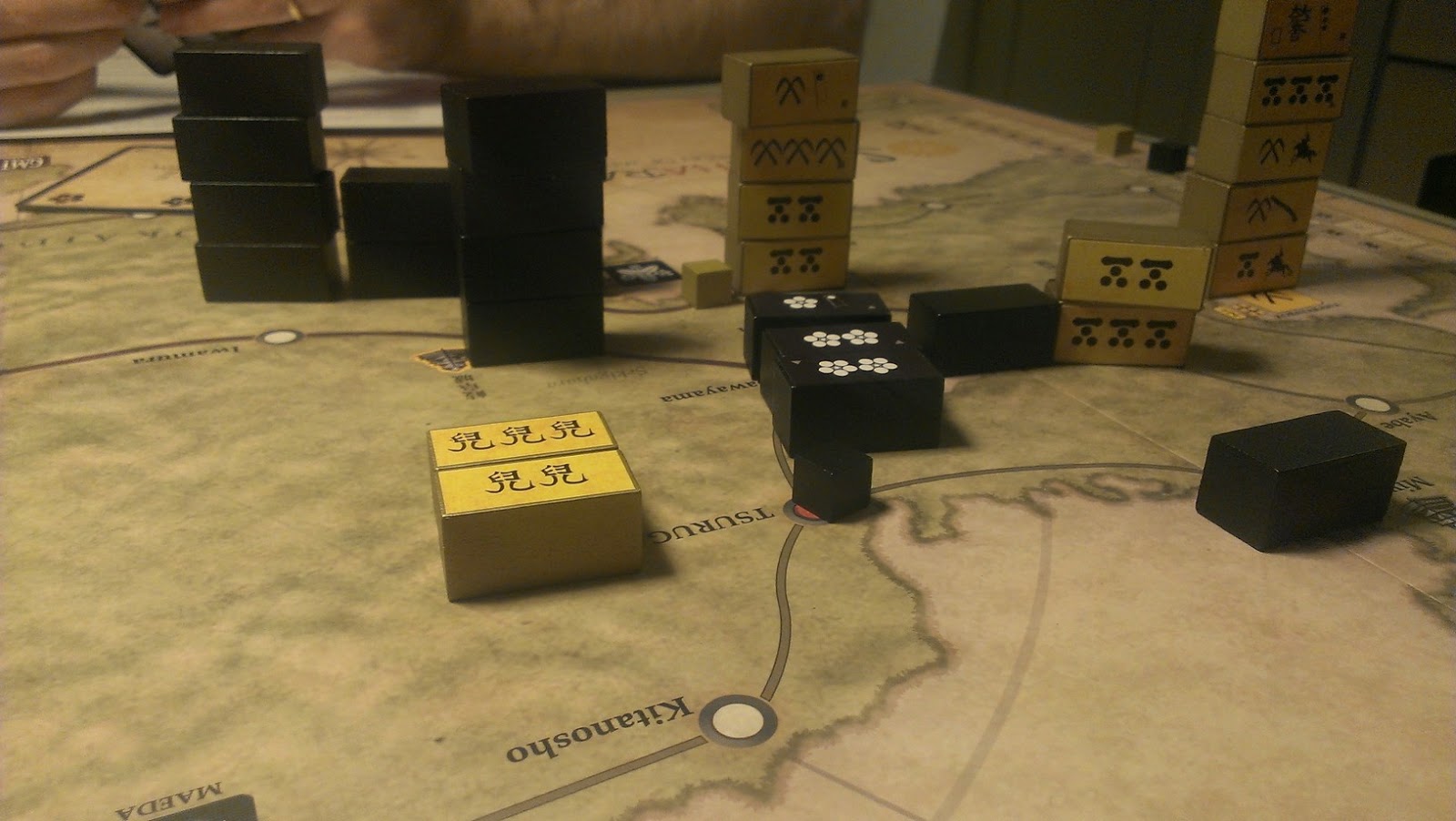
As the evening threatened to turn into morning, we kept playing, fighting and jostling for position across Japan. There was a period of hysteria on my part when Joe kept knocking over his stacks of generals. I imagined the game redesigned by MB Games as a knockabout dexterity game. “You've knocked over my samurai!” was Joe's suggestion for a tag line.
As midnight rolled around, I hauled my largest army out of the safety of Osaka and into Kyoto, where Joe's largest army was waiting. It was a grand battle, with two generals defecting to the other side, one going each way. They probably exchanged pleasantries as they passed each other by.

Joe, as the war lord Tokugawa, won that battle, and I admitted defeat just after midnight. Technically I still had armies on the board, but time – the biggest enemy of all – had the final say.
So, four games and four wins to Joe. Plus two historical games with factually accurate endings.
