Sunday, 28 June 2015
It’s a shame about Reille
Since it was a nice warm evening, we decided that today would be our only chance to play outside. We began with W1815, a game that recreates the Battle of Waterloo in fifteen minutes. Technology, eh?
This is a war game based mostly on the roll of a dice, although there are limited ways to offset losses if you’re British. It’s very historical, with the names of various generals (including Reille, as immortalized in the blog post above) and certain real events portrayed in the game, like Ney's Cavalry Charge. When this is triggered, a red mist descends upon one of your generals and the only move you can make is for him to keep charging until he dies or rolls a 1 or a 2. At this point, he calms down so you can do other things.
We played it twice, taking turns to be the French/British. And both times the British won! However, Joe’s victory was more overwhelming than mine and he was the overall winner 39-32 or something.
After this, we played Cities. A kind of mini-Carcassone, where meeples score for their areas and surroundings. These areas are built up using a Take It Easy style one person draws tiles at random and the other takes the same tile from their stack.
It was quick and easy and very easy to pick up. I enjoyed it for the short time it lasted, but I didn't win. I didn't keep a note of the scores. Somehow, playing games under the gaze of the moon meant that winning or losing didn't seem important.
Next up was Aton. This was my first game, but the rules were easy enough to understand. I couldn't withstand the onslaught from Joe's experience mind, though. We played twice: the first time was closer, and the second time was something of a rout.
By now it was 9.30, and it was cold enough for us to decide to go indoors. Now we had a larger table and still a couple of hours, we went for something a bit more meaty: Sekigahara, the unification of Japan. Joe assured me that the rules were simple enough, though as ten o'clock ticked past, I started to get a bit nervous. They're simple enough once you get going, but there are lots of exceptions.
Basically, you have armies of various clans, but when it comes to battle, you cannot use them unless you play a card with the same symbol on it. Additionally, your opponent may play a loyalty card – nothing to do with supermarkets, but a test to see if that army really is loyal to your cause. When this happens you have to play another card with that symbol on it, or watch it defect to the other side.
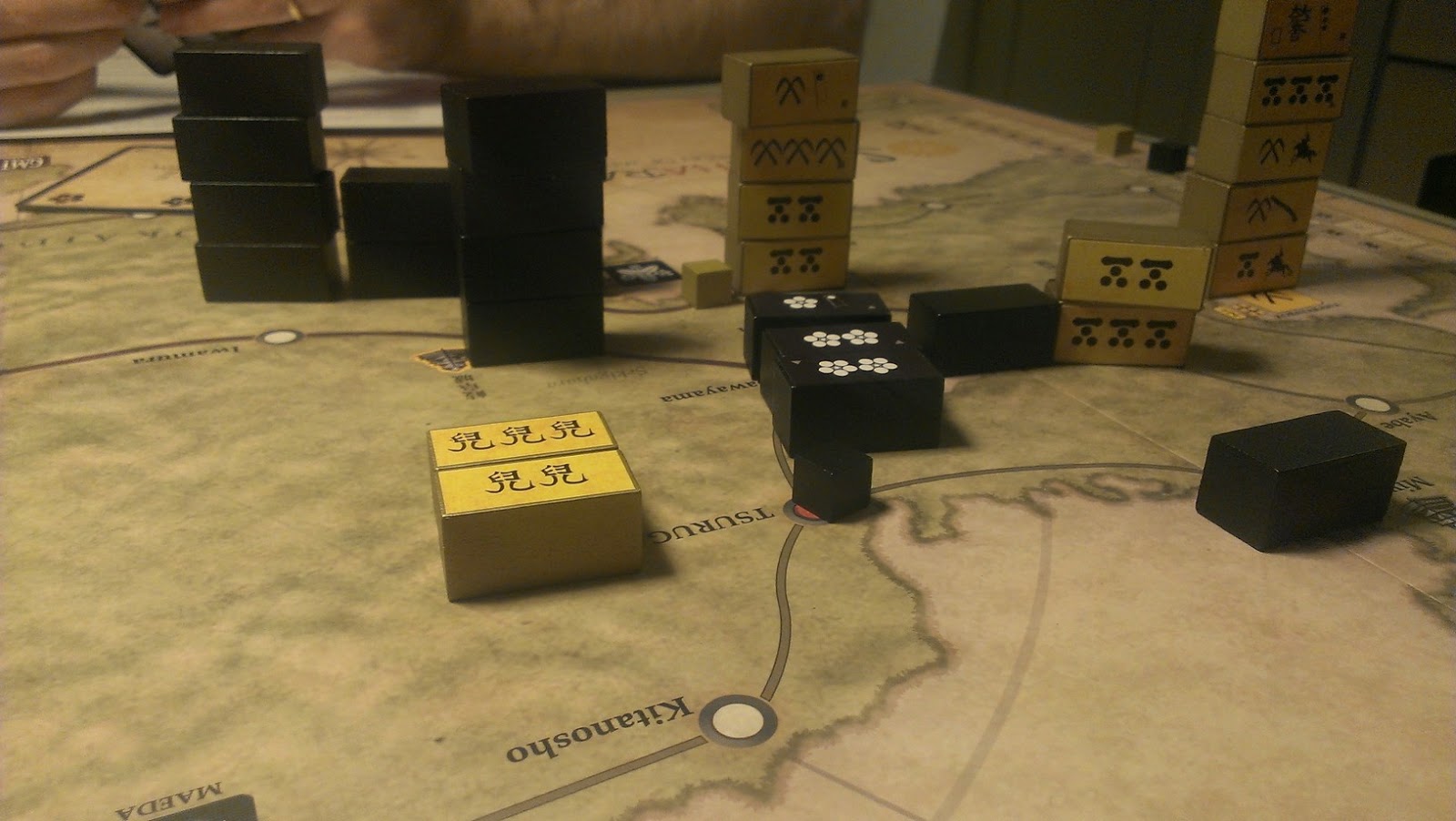
As the evening threatened to turn into morning, we kept playing, fighting and jostling for position across Japan. There was a period of hysteria on my part when Joe kept knocking over his stacks of generals. I imagined the game redesigned by MB Games as a knockabout dexterity game. “You've knocked over my samurai!” was Joe's suggestion for a tag line.
As midnight rolled around, I hauled my largest army out of the safety of Osaka and into Kyoto, where Joe's largest army was waiting. It was a grand battle, with two generals defecting to the other side, one going each way. They probably exchanged pleasantries as they passed each other by.
Joe, as the war lord Tokugawa, won that battle, and I admitted defeat just after midnight. Technically I still had armies on the board, but time – the biggest enemy of all – had the final say.
So, four games and four wins to Joe. Plus two historical games with factually accurate endings.
Monday, 15 December 2014
Khmer and say that
I offered to play West for the first time; this may have given Martin the impression that I had been reading up on strategies. Our experience has been that it is very hard to win as West, but various posts on BGG seem to show the opposite.
In any case, I had one aim and one only - to build up living standards in West Berlin to unfeasibly high levels, and let the sound of clinking champagne glasses and high-living drift over the border and make the socialists furious with jealousy.
Unfortunately, while I was doing that I forgot to make things difficult for Martin in other ways, and he built up a decent economy and started to raise his living standards. Which made my plans redundant. I was able to seed a Western Currency crisis in the last two decades, but by then the damage was done. Martin's socialist ideology had so gripped the nation that it looked like he would win as we unravelled the final decade. I'd spotted this, and my one chance to stop it happening was to force him into insolvency. However, his economy, though decimated by the 70s, wasn't quite on the point of collapse, and so his Socialists triumphed. Even if they hadn't he'd have won by surviving all four decades.
Another good game, though I admit to not having a firm grasp of the full workings of either side. I'm still enjoying it, though every game seems to have a point where I get a stay of execution because Martin makes a wrong move, spots it too late and curses his own idiocy; which is not quite as satisfying as me being actively clever. I liked playing West though, and would like to do so again next time.
(I'll have to add a picture tomorrow as I can't seem to upload to blogger from my iPad).
A full four decades game took about two hours, so it had only just gone 9pm when we finished; Martin couldn't quite be persuaded that it was early enough to play Commmands & Colours, so we got out old friend Aton instead. Two really interesting games, quite unusual - Martin won the first on the insta-win by filling temple one; the second super close, Martin winning by a point after the second scoring round. He scoffed at my attempt to intimidate him with my greens, but I was closer than he realised. Only a shit hand with no fours stopped me making it a very real possibility, which would have made things even more interesting.
Finally we played Khmer - a much closer game than before, starting with a completely symmetrical hand, which Martin won for a 2-0 lead. He won the second hand too, but I won the third, bringing the score to 4-2. In the fourth hand, I correctly deduced that I couldn't win and folded, leaving Martin a single point from victory.
He then folded on the fifth hand, and the scores were 5-3. Interestingly this was the first game in which either of us had folded, and we both called it correctly. By now my brain was melting, and in the sixth game I made a silly error, giving Martin two points for a 7-3 final score.
Great games all, and nice to know that games were being played elsewhere in the GNN-o-sphere at the same time. We are all made of meeples.
Wednesday, 26 November 2014
Sivél Disobedience
So Martin and I (Joe) got to play games to the tune of "Just the Two of Us". Martin had been itching to get Wir Sind Das Folk! to the table since a friend brought it back from Essen for him, and I was cautiously happy to oblige (having failed to round up the four players needed to break out the most un-GNN-esque Sons of Anarchy - for which I have high hopes).
WSDV is a political game exploring the relationship between East and West Germany from the fifties through to the eighties. If East Germany can survive all four decades with communism intact they win, otherwise the West prevails. Either side can win sooner by forcing levels of unrest into outright revolution.
It comes in a delightfully small box, and has well thought out graphic design - the same designer Richard Sivél (hence the post title) was responsible for Maria, an equally elegant and even prettier game about the Austrian war of the accession.
Andrew, Adam and I played Maria a couple of times a few years ago, but it proved just a little too complex for our feeble minds, and was reluctantly traded away.
Complexity is certainly evident in WSDV - my heart sank a little when, after 25 minutes of rules explanation, Martin said "This is where things get complicated...". But after something like 40 mins we were ready to play, Martin as West Germany - me as the East.
The game is asymmetric to a degree, and bears similarities to Twilight Struggle, though you are not fighting over territories so much as fomenting unrest in each other's provinces by making life unbearable for each other by comparison.
In basic terms, you build up factories and infrastructure in your regions, which allow you to raise the standard of living and thereby quell unrest. If one of you raises living standards above that of your opponent, unrest will begin to foment.
However, you have to balance the standard of living within your own country, otherwise you'll sow the seeds of disquiet at home.
Each of the four decades is a round in which decade-specific cards are available for both sides to play. At the end of the decade, a checklist of states is compared, including East German flight, Western currency, prestige, living standards etc. The consequences of these trickle down to the map, degrading infrastructure, fomenting unrest and generally messing with your shit. If at the end of this either player has four mass-protest tokens on the board they lose, otherwise you push on into the next decade, broken but un-bowed.
| the '70s in full swing |
It was Martin's second game, my first, and there was scant room in my brain for strategising. I just planned to cling on. Martin missed an early opportunity to do some serious damage to me (and I wouldn't let him take his go again), and I managed to struggle through the decades relatively unscathed. I denied his West German's the invention of colour tv, which send to annoy the hell out of them, but as the third decade drew to a close, Martin announced that he now realised what he should have been doing.
| some West German mass-protest up close |
He belatedly tried to put this plan in to action during the final round, and nearly did it, but just didm;t quite have the head of steam needed to topple the East, and I won the day.
It was a very interesting game - far more opaque than Twilight Struggle but with a few more plays I'm sure the rules would crystallise and it would become the pure battle of wits we all want from a game. We both thought that the extensive use of icons somewhat diluted the historic resonance of the events, but it made it very clear what one stood to gain or lose from the use of a particular card.
Martin noted that I had done none of my special actions, sending in the Russian tanks or building the wall for example - I had effectively ignored the trappings of communism and won by treating the East Germans to a fairly capitalist existence (whilst denying the West their colour TV). That seemed possibly a little odd - there seemed to be little imperative for the East to operate within their ideology. But we may have played something wrong, or I may just be missing the finer points of the asymmetry. I'm going to read up on the rules now, ready for the next bout.
We just had time for a quick game of Aton, in which the whisky got the better of me and I let Martin dominate the second scoring round for a neat on-the-nose 40 point win.
Thursday, 6 February 2014
Highs and L.O.W
Due to our collective experience it was going to be a close contest. It became obvious after the first few rounds what type of cards we aiming at to gain the extra lord bonuses and even though we both sought Warfare it didn't create any problems. With both of us completing a mixture of helpful low scoring cards and picking up goodies or plot quests (On going bonuses) and expensive big scorers our little scoring counters played a twee game of leap frog around the board. In round 8, the final round, I was able to complete one more quest than James which pushed me ahead just enough to escape his impressive 10 card and forty point bonus at the end.
Chris - 207
James - 188
Next up Aton. Both of us needed a rules refresher. The winner of this game was going to be the person who could recall any tactics from the many matches we had played in previously. In the past James was quite a pro at this one. Although the rules were a little hazy the successful tactics had remained hidden in a tiny unused section of my memory marked "winning moves" and suddenly I was filling up the temples with red markers and scoring heavily..
Chris - 61
James - 34
No idea what this does for our mini league. James might know. I think I'm still a big behind.
Thursday, 19 December 2013
Aton of fun!
Here's his reaction:
Wednesday, 16 January 2013
Batteries recharged
While we waited for Steve and Anja to arrive we decided to play a game that Anja would never agree to if she was here: 6nimmt. This simple game of card placement has a winning strategy just as enigmatic as Biblios, but is funnier. We ended the game after the round when our two companions arrived, all rosy-cheeked and fresh from the winter air.
![]() |
| The most confusing cards on 6nimmt |
Adam 42
Joe 48
Andrew 55
Sam 60
The sad news is that this is the last Tuesday for Steve and Anja, since pre-natal classes start next week. We all hope they'll be able to make the extra-curricular games nights that will crop up now and again.
We split into two groups: a game of four and a game of two (now that I've devised a two-player leaderboard, more of which later). Adam and Joe played two games of Aton while Sam, Anja, Steve and I played Downfall of Pompeii: The game of populating a doomed city and laughing at everyone's untimely demise. Sam explained the rules to Anja and Steve.
During this game, disaster struck. Not the volcano, a proper disaster. I knocked over my bottle of Bishop's Finger, and although the spillage wasn't great, there was a minute or so of holding the board gingerly off the table so the meeples didn't slip while some quick mopping was done. And on Joe's lovely green baize, too.
It's not a game for people who hold grudges, and sitting next to Anja, I was acutely aware of her barely disguised snorts of disgust whenever I chose one of her meeples to put in the volcano. However, it was Sam who was most picked on, and he came out the worst in the final count, with least escapees and most of his relatives in Vesuvius.
Steve 10
Andrew 9
Anja 8
Sam 6
During this time, Adam and Joe had played Aton twice. In the first game Adam won an "absolute victory", while Joe pipped Adam in the rematch.
Adam wins!
Joe didn't
Joe 42
Adam 35
Finally, with Stave and Anja's time on the car club running out, we decided on a quick game of Coup. This, too, was new to Anja and Steve but they seemed to catch on soon enough. Well, at least Anja did. We played one game, during which Steve extended their time with the club car. That makes me feel a little bad about being the one to kill him off first... but not that bad.
1. Sam
2. Anja
3. Adam
4. Andrew
5. Joe
6. Steve
![]() |
| Oh Captain, my Captain! |
Then, since Steve had extended the time on the club car, they decided they had enough time for one more game of Coup. Unfortunately, since Anja was doing so well, they had to extend again. If there was a category on the leaderboard for most money spent during a game, I'm sure Steve and Anja would be top.
However, Anja was not to be victorious. I'm not one to boast, but I'm quite proud of the way I played a hand which would usually be considered the weakest: Two Contessas (who do nothing except stop assassinations). After the first (and only other) Contessa was revealed early on, I started to act as if I had an assassin. Since I knew they couldn't possibly have a Contessa, I felt confident and that confidence made a difference. As long as I made sure no one got enough money, I could assassinate with impunity and I ran out quite a comfortable winner.
1. Andrew
2. Anja
3. Joe
4. Steve
5. Adam
6. Sam
So the evening ended with our faith in board games reaffirmed. Sam takes a tumble on the Form Table, and Steve's season is still to get started.
| Points | ||||||
| Andrew | 1 | 4 | 2 | 3 | 1 | 11 |
| Adam | 5 | 3 | 2 | 1 | 1 | 12 |
| Joe | 3 | 5 | 1 | 2 | 2 | 13 |
| Anja | 2 | 2 | 3 | 2 | 5 | 14 |
| Sam | 6 | 1 | 4 | 4 | 3 | 18 |
| Steve | 4 | 6 | 1 | 5 | 5 | 21 |
Meanwhile, there's the business of a two-player form table to sort out. It's always been a bother that the good people of Bracknell have not been able to pit their wits against ours, but now I've gone some of the way to put that right. The two-player system uses the same system as The Division, but it needs a third player to make it work. If the game is new, then an average score from the first session report that I find on Board Game Geek is used as a dummy player. If it's been played before then the previous scores of the player(s) act as a third (or even fourth) dummy player. So, make sure you improve on your last performance or else you may up with less than bronze in a two-player game!
This is how it stands to date...
With the most recent report from Bracknell being a three-player session, maybe those can be added onto the The Division as normal.
Wednesday, 4 January 2012
January tales.
Totally disregarding Paul's open dislike for card based games I unboxed Dominion (Intrigue) to see if his mind could be changed. I chose a party time style set of decks to see if the freer play would help Paul enjoy the game. Dominion is one of those games for us that always needs a rules refresher. Even so some of the cards had us a little confused due the use of the word "Gain" and early progress was slow. Suddenly it all clicked and we were racing through our decks with a barely a pause. (Save for Boris shinning up my leg, clambering onto my laptop and onto the table for a good nose round).
In the games dissection afterwards we noticed that Paul and I had selected differing strategies, with him only using a Bridge, Pawn, Upgrade combination where as I tried a bit of everything but stuck mainly to Great halls and Nobles with a few pawns thrown in for good measure.
Somewhat surprisingly the game ended a dead heat, 58 points each. Checking the rules the only other differentiator was the amount of turns, which was equal. Therefore, the rules declared, we should rejoice in our shared victory. So we rejoiced.
Next up Paul's choice Ticket to Ride. I tried the accepted card hoarding method and really long route, whereas Paul set about adding fistfuls of tickets and creating a sort of explosion effect in the middle of the map. Paul's bravado paid off even it nearly backfired on him. His superior haul of tickets beat my massive chain which nearly reached from the west coast to the east and back again.
Paul - 109
Chris - 94
There was just time to fit in a game of Aton. The game was actually closer than the final scores reveal, but my last hand of 4,4,3,3 was too powerful for Paul to defend.
Chris - 49
Paul - 29
Honours even for the night then and so we rejoiced again. On the journey to the train station I promised Paul some new games for the New Year. It's a tricky thing getting well balanced two player games so any suggestions are welcome.....
Thursday, 27 October 2011
Down through the centuries (and along the M4)
Chris 89
James 62
The game is not a short one and with the rule learning thrown in it was all we could play that night.
On Tuesday Paul made his bi-weekly pilgrimage to Bracknell for some good clean honest gaming fun.
We started off with a couple of games of Aton. With a few games under our belts we are starting to see the subtle strategies involved in this seemingly innocuous game. The first match was a straight fight for Black bonus squares and temple number 4. The second evolved into quite a difference of approach as I discovered cramming the first temple with all my counters changed the pattern of the game completely. Both matches swung my way finishing thus;
Chris 40
Paul 17
Chris 54
Paul 32
Then we moved onto a personal favourite and GNN classic Stone Age. Paul professed after the game that he hadn't actually 'Got it' until today and his new found enlightenment certainly provided a close game. Stone Age is a game which scales to two player perfectly, and with the reduction in huts to two stacks of seven it creates a further aspect of being able to effect the timing of the games end. We found our game ending prematurely with half the deck of civilisation cards left to go. The final tot up saw my civ card haul match Paul's impressive hut multiplier but my better axes and field scores pushed me ahead.
Chris 151
Paul 141
We had just enough time for Paul to thrash me at a third game of Aton as my wacky temple 1 obsession backfired on me.
Paul 40
Chris 22
Wednesday, 12 October 2011
Peak Games
We decided to kick the evening off with Aton, a new game to Paul. After listening intently to my 'expert' explanation of the rules he manfully tried to look less confused than he actually was and agreed to proceed. My recent experience and Paul's lack of showed early on as I bounded round the scoring track and filled up the temples with blue counters as I went. After the first scoring round I was in a commanding position. However, the penny dropping in Paul's mind was almost audible as he embarked on a determined fightback. Alas to no avail as a second scoring round saw me launch over the line.
Chris 45
Paul 28
Buoyed by his finishing charge and the realisation that the black squares really are a winning move, Paul asked if we could play another game of Aton. The first game had finished quickly and it wasn't even 8pm yet so we set up another round. As is typical with this more abstract type of game, once my opponent actually grasps the rules I'm often left clinging to their coat tails as they forge a path of superior tactics and logic. Paul duly obliged and by the end of the first scoring round was in a formidable 10 point lead. I shifted my strategy to one of trying pinch cheap points to close the gap but unfortunately Paul cottoned on to this and began to block. The game ended a closer affair than the final scores suggest, Paul getting a couple of useful 4's in his hand before the final scoring round.
Paul 44
Chris 33
With the night still young we moved on to our main game of the evening. Paul quite graciously accepted my request and puppy dog eyes to play London, a game introduced to us by Sam at Septcon. After a quick rules refresher we were off, blue prints in hand and appointments in the book to see the bank manager in the morning. Early on it would seem that we both had the more cautious approach of the three player game in our memories as we both made small display stacks and concentrated on building as much money as possible. Slowly it dawned on us that the resource restriction of a third player wasn't there and you could play as expansively as you liked. Paul in particular raced ahead in his stack building and showing an utter contempt for the arts and culture as he proceeded to build an empire based on hard economic reality. I however, saw that Paul was starting to burn himself out and plumped for a borough domination tactic and a balanced stack. As we two mavericks of industry forged ahead poverty became a thing of the past in our utopian society. Finally as the two hour mark neared and we had exhausted the card deck the final tot up showed that my 11 boroughs and 6 underground stations out weighed Paul's card victory point haul.
Chris 116 (Money=10, Boroughs=57, VP Cards=25, VP=24, Pov=0)
Paul 100 (Money=13, Boroughs=38, VP Cards=30, VP=19, Pov=0)
I like this game even more now I have played it again but I would have liked to have seen a more restrictive two player version than simply a smaller card display.... Maybe the BGG community has some suggestions..
Tuesday, 4 October 2011
Bracknell Discoveries
Having played the original version of Carcassonne several times we were quite interested to give the game's Discovery variation a play. This version is sold as game in its own right rather than as an expansion, where the fields remain but the cloisters, roads and cities are replaced by individual cities, mountains and seas. The scoring for these areas, although similar has some crucial differences where incomplete areas can be scored - albeit for less points - during play, meaning there was a steady build up of points. Also the escalating contention for the high scoring farms is completely eradicated thereby removing the single winning route to victory that the first version suffers from.
So to the game itself. Initial scoring was spread equally between us but after a run where I picked up a bunch of tiles with cities on I was able to place myself in a strong position and scored accordingly. This proved to be enough as I held off a determined fight back by James to win by 20 points. On reflection we both enjoyed the Discovery version but rather felt that we liked elements of both.
On to our second game of the evening, Aton. Some 3 weeks ago James and I attempted to play this but after one and a half frustrating games we decided to pack it away as neither of us were enjoying it at all. In our eyes it didn't seem to work and was very unbalanced. Convinced that we must have interpreted the rules incorrectly we took another look. Sure enough we had. The crux of Aton is whether you get to place your tokens in the temples first or second but equally important you both get to remove your opponents tokens as well. We had been playing that only the winner of Cartouche 2 got to do that, and as it was generally a low number that won, nobody had a card high enough to remove any counters and the temples just filled up.
Unfortunately for me James is rather good at playing this type of game and wiped the floor with me in the first tie winning by 51 points to 23. In the second match I faired a little better and took the game to an exercise in brinkmanship as we both hovered by the 40 point winning margin. However it was James again who prevailed as I dealt myself a hand of kakka poo and my exchange token had already been used. James sailed past the 40 point mark and into a 2 - 1 lead on the night.
Aton is a great, quick little game with some subtlety to it and is a much much better game if you play by the correct rules
Tuesday, 23 August 2011
Bonjour Bristol
I go away for two weeks, and we have branches? At least it's not factions.
If this continues we'll be able to have a Eurovision style contest - 'Wilkommen, Bracknell - can we please have your scores for Ticket to Ride'?
But really, the more the merrier. If I'd had internet access out in France I'd have joined in. But I didn't, so I couldn't. I did manage to get some games played though.
I was only allowed a small-ish bag of games, so I took my box of card games, Stone Age, Thurn and Taxis, Pergamon, Dixit and Battle Line.
However, the Thurn and Taxis box also contained Settlers of Catan.
In the Pergamon box I'd managed to find space for Notre Dame and Aton, and secreted within the capacious Stone Age box were Alhambra and Lost Cities.
The Battle Line box also held Haggis, Row Boat and Citadels, and the Posion box is far too big for the game itself; much better with Tichu, For Sale, Mu, No Thanks and Coloretto in there for company.
And what did we play?
If it was up to Bea (9), we'd have played nothing but Dixit. It was in fact one of the game highlights of the holiday, playing Dixit in the garden with the girls and my parents-in-law.
I can't think of another game that could be played by six people aged 7 to 70, first-time and seasoned gamers alike, that would be such fun, and a proper game - it's a worthy Spiel Des Jahres winner, and a very unique game.
My father-in-law William is always up for a game, and I had high hopes for Aton, mine and Sam's current two-player favourite. We played once, but it didn't really grab him.
We played a few games of Battle Line, a great Reiner Knizia two-player card game of war in the ancient world - very thematic, even though you're basically making poker hands. But the one that William really took to was Lost Cities; RK again, and a game that really deserves its classic status - everyone I've introduced it to 'gets' it within a single round, and wants to master it. It may be less strategic than Battle Line, but easier to grasp, pick up and play.
Matilda's go-to game was Coloretto, and I played a few games with all the girls; despite the fact that their main strategy was fighting over who got to collect pink, I consistently lost . . .
In exchange for taking them swimming one gloomy afternoon, Matilda and Bea agreed to a game of Thurn and Taxis; Bea won, but they haven't asked to play again. Funny, I thought Matilda might find it an interesting step up from Trans Europa.
Again at Matilda's request, we played a game of Alhambra, and I was reminded of what a great game for three or four it is; and what a long one too, for kids.
And in the evenings, Charlotte and her mum were persuaded to join us menfolk. That's when I realised I'd brought too many games. I couldn't decide what to play; the first night we played Tichu, which didn't go down a storm. I should have learned to avoid card games after that, but the next night, despite showing them both Pergamon and Notre Dame, I ended up suggesting Mu. I found a good teaching method, but we started too late, and it was a giant flop.
Everything changed, however, after I sniffed out a games shop in La Rochelle . . .
I couldn't resist Martin Wallace's new game, A Few Acres of Snow; it's a two-player game based on the battle for control of Canada by the British and the French, which uses a Dominion-style card-drafting mechanic. No, Charlotte didn't play it; and by the time I'd got to grips with the rules, William had headed back to London.
But while I was there, I picked up Pickomino - the Reiner Knizia dice game some of us played at Stabcon with Hammy (he called it Heck Meck). It turns out that if you're allowed to play it yourself, rather than being told what you should do on each roll (Hammy's preferred method), it's really rather good fun. We played it with Charlotte's parents, and I played it with the girls. And finally, we all played it together; in fact we played it every day of the holiday after I bought it.
It's a good little push-your-luck dice game, the pieces are very tactile and lovely, and the worms give it that extra hook for the kids. There's an awful lot of luck, but that's perfect for what it is; and when the dice-gods smile on you, and hand you the single, solitary worm you so desperately need on your eighth dice, well, you smile right back at them. Would make a nice game to end a tuesday night . . .
So Dr Knizia does it again - I could have just packed Pickomino, probably.
Except the box is so small, I couldn't possibly have squeezed the other games in there. JB
Friday, 29 July 2011
Aton smashing!
My tireless searching has thrown up a few gems that fit the bill; Haggis is a superb two-player card game, and Coloretto with two is good as well. But sometimes only a game with an actual board will do. Pergamon is great with two, and very dinky (important in the cramped environment of my drawing-cupboard) but a little over the strict half-hour time limit, especially when you factor in the fiddly set-up. Through the Desert, same. TransEuropa? Board is too big, and not enough strategy. Hey, what can I say: I'm picky.

Now I can add Aton to the list of strategic, involving half-hour two-player experiences; and it seems, even after a first play, to succeed where others have failed. It's small and compact, very quick to set-up and play, strategic, with lots of interesting decisions, but enough luck to mitigate any hard feelings.
It's an area control game, with players placing pieces in one of four areas (temples) on the board. When a scoring round is triggered, the player with most pieces in each temple gets some points, with each temple offering different criteria. There is a theme, but it's so papery light as to be non-existent, and it doesn't matter; it's just red versus blue, and that's fine. The fun comes from the multiple possible strategies, and the presence of several instant win conditions - while you're busily persuing points, your opponent might just whip the entire game from under your nose by filling an entire temple; stay on your guard!
A deck of cards numbered one to four determines how many pieces you can remove, play, and where you can play them. Each round you deal four cards to yourself, and assign them to four slots on your side of the board. If you've dealt yourself four fours that's terrific. Four ones; not so good. More often you've got a single four in there, and then you have to decide whether to use it for placing counters (meaning you'll be able to place four counters), or for determining which temples you can place in (meaning temples one to four), etc. It makes for some tense decision-making.
Another of your cards will determine how many pieces of your opponent's you can remove (or sometimes your own). Counters you remove go into a track with nine spaces on it, and when that's full it triggers a scoring round.
This control over the scoring rounds makes for some added strategising; if you can just hold off triggering a scoring round for one more turn, maybe you can get a majority in that all-important 4th temple.
Given the overall elegance of design, it might not come as surprise that the game was created by Thorsten Gimmler, the guy behind everyone's favourite filler, No Thanks!
It came out in 2007, but is readily available online, and relatively inexpensive (£12+ vat).
This post is starting to sound like an advertisment feature, so I'm going to stop now. But if you ever have half an hour to spare and fancy a game, you know where to find me. I'll leave the board set up. JB


