Showing posts with label Alchemists. Show all posts

Sunday, 15 October 2017

The Unified Theory of Nothing

I sat down to write up our second visit to Alchemists, and found myself joined by two miniature co-authors. So here's a three-person report on our Sunday games session:

Sam: On Sunday Andrew joined Stanley and I for a bash at Alchemists. We (me and Stan) had already played a 6-round game of A Feast for Odin by the time he got here, so we were really in the zone.

You have to be in the zone to play Alchemists. Although there's a very strict logic at play here, working everything out isn't easy.  For someone like me, who goes blank at long division, trying to break down the very components of life itself is a challenge.

Stan: I won A Feast for Odin, by the way.

Sam: Yes. Anyway...

Stan: By quite a few points.


earlier

Sam: Yes. So with Alchemists - as I tried to write in the previous post - you're making and selling potions for gold to buy artefacts to get points, but that's kind of the day to day business. What you're really trying to do is work out what the (al)chemical components are to your ingredients. Do that, and you can publish theories about your work and improve your rep.

Stan: A Feast for Odin is much better. 

Sam: Alchemists is fascinating. I don't know if I think it's the 52nd best game in the world, or even the 52nd best game I've played, but it is definitely very different.


Stan: Yeah, but A Feast for Odin has a good tang to it and it's like a thousand times harder to do, so I'm much better at playing games than you are!

Sam: What Stan is trying to say is that I trounced them both at Alchemists. And what I think is fair to add is that we all went seriously wrong in our deductions. Both Stan and I spotted Andrew's first theory was incorrect, and we raced to debunk him. But Stan also tried to debunk my theories three times and failed - even though my theories were actually, it turned out, utterly wrong. I meanwhile managed to eliminate every single alchemical as a possible match for not one, but two ingredients. As an alchemist I was essentially moronic. I had no idea how to utilise the knowledge of neutral matches, and I still don't.

Joe: I wasn't even there, but I just like saying stuff. 


Sam: The best part of Alchemists is the final reveal, where you uncover the actual alchemical for each ingredient, and reveal everyone's theory. Of the eight, we had two right - an exceedingly poor return for supposed experts!  I pictured us all shuffling out of the conference with our heads bowed, trying to spin it that we had made great progress...

Joe: I hate alchemists!

Sam: Thank you, Joe.


Stan: All you have to understand that A Feast for Odin is a very technical and strategic game and should be given more importance to than a rubbish game like Alchemists.

Sam: Despite the late drama where I lost about 12 points, I still hung on to the lead. I should add in fairness to Stan that he forgot to exhibit potions in the final round. And in fairness to Andrew that he wasn't aware of the terribly punitive effects of having your theories debunked, as his were.  I had neglected to explain it, as in mine and Stanley's two-player we'd never dared cause that kind of consternation in the alchemic community.

Stan: You could also add that I won A Feast For Odin?

Sam: I think they got it.

Friday, 13 October 2017

Turning cardboard into gold

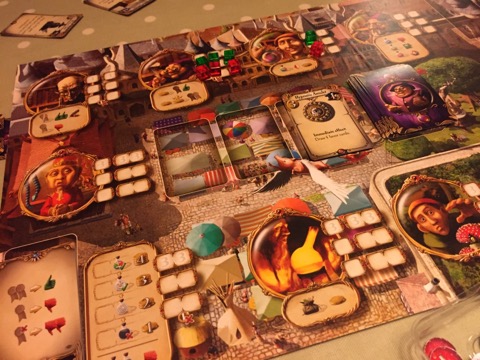
Alchemy! The art of turning base metal into gold... or in this case, turning toad and leaf into a potion of healing. I picked up a half-price copy of Alchemists this week, courtesy of trading in Steam Park - turning steam-punk amusements into life or death elixir.

It's a very unusual game, in part because it uses an app. Each of the game's six ingredients have a corresponding 'alchemical' comprised of three parts: red, blue and green circles. A circle may be large or small, and each contains a symbol of either positive or negative. During the game, you mix these ingredients together to make potions (or soup) and at the start the app randomly (and secretly) assigns each ingredient its alchemical.


The game itself at first seems like a worker placement thing: you use actions to gather ingredients, turn them into gold, combine them to sell potions to adventurers, use gold to buy artefacts, and test potions - on either a willing (sometimes more willing than others) student, or yourself.  Each potion has a symbol, and you keep track of how you made things behind your individual screen.

And then you realise it's a deduction game. As it goes on, you use the information you're gathering about how the various ingredients interact to figure out what each ones alchemical is. If, for instance, scorpions and frogs combine to make a potion of speed, this is defined by a blue plus. You don't know yet what eithers' alchemical is, but you do know that scorpions and frogs alchemical won't have a blue minus on them, so these can be eliminated on your secret pad.


And as the game continues further, and you gather more knowledge on how the ingredients interact, you can announce the theories to the world you've developed in you secret lab/pad, by placing the alchemical and ingredient together with a seal that represents your theory. You gain reputation by doing so - but theories can be debunked (even by yourself) later, so there's room for a little shenanigan-ing here.

There's more to it than that, but basically the app comes into it for combining ingredients to make potions, selling them and testing them, and checking everyone's theories at the end of the game. In the final round there's even an opportunity to show off your potion-making to the wider world and gain - or lose - reputation. Inevitably, you ultimately live or die by how good an alchemist you are - if your theories are lousy, you lose rep. And - though the game doesn't mention it in the rules - if you make a mistake on your secret pad, you also lose rep: both in the game (can't really have a theory about scorpions if you've managed to cross every alchemical off) and in real life, as you realise in your foolishness you've eliminated every single alchemical for mangrove root.


Stanley joined me halfway through a playthrough and afterwards announced "It's a brain-burner". And it is. Not only the deduction, which has the get-there-first tension reminiscent of Mystery of the Abbey, but how the actions play out. Turn order is really important, as there's a Fresco-style benefit to getting up early and taking actions first. There's also a fight (in the two-player game) to sell potions to adventurers, with some blind-bidding thrown in to decide the winning vendor. It's one I definitely want to play again (maybe with three), but I think we'd need three hours for a first play, so it might not be one for a Tuesday...