
Showing posts with label homegrown games. Show all posts
Showing posts with label homegrown games. Show all posts
Wednesday, 5 March 2025

Sunday, 10 July 2016
Dice in Spaaaaaaaaaaace
With Chris unable to make it until later in the evening, Ian and Andrew obligingly indulged me in trying out my (Sam's) latest game design last night. Its mechanics are openly purloined from games I enjoy - there's the regular combat and sense of a race from Quantum (and three actions each turn) , the planet tech of Ascending Empires, and the chance-based jostling for position in Lords of Vegas. But in Orbital, the planets keep moving.
The game takes place in a five-planet solar system and the players represent newly-arrived competing cultures, fighting over the planets. You begin with two ships in the form of dice, and during each turn you can move, settle on planets, build more ships, combat other players - either in space, or attack a planet - or cause an uprising on a planet where you have a settled ship. The last one is the heart of the game, because if a player has the highest value die on a planet, they have dominance there. Not only does that give you a boost during play, it's also key to winning: the game ends when one player gets dominance on all five planets concurrently. It's kind of Lords of Vegas in space in that regard - I nearly called it Spagas, only that sounds like a fungal infection.

There's a couple of other actions too, but mainly you're flying around, blowing each other up and landing on planets - there's only space for four ships on each planet.

At the end of each round, all the planets move along their orbital paths, so you have to take your moment if you can, or you'll be left behind. And at the start of each new round, players pick up resources for each planet they occupy (being dominant gives you an additional resource cube) and these can either be spent during your turn (cheaper building, free moves, dice-rolling bonuses and hyperspace!) or saved for points at the end of the game.

The idea was to make a feisty game where players are encouraged to go all out attack (trying to get dominance in all planets) or consolidate by stockpiling resources. But of course, you can only stockpile cubes if you're picking them up in the first place...

We played nine rounds in a little over an hour. I'd fallen away dramatically and had taken on some debt in order to build more ships. Having done so, I sprang back into what I thought was contention - gaining dominance in two planets. But the very next turn Andrew got himself back on top in four of them. He then went for the fifth, knowing if he managed to roll a six, he'd grab the planet and mostly likely the game. He rolled a six!

Andrew 31
Ian 23
Sam 12
Hard for me to be objective, especially when throughout I was worrying if it was too fiddly/too luck-based/too X. But I think I enjoyed it.
With that trial by fire out the way, Chris was yet to arrive, sending us a mysterious text about poop.
So we decided to give Madame Ching another go; the board game that's actually a card game. The game played very fast - only 30 minutes - and whilst no-one made it to Hong Kong or claimed the China Pearl, we did at least give the impression we knew what we were doing this time.
Andrew 25
Sam 22
Ian 21

As we were debating what to play next Chris arrived. Having cleared up the mystery of the poo text, and cleared up the source of the poo text as well, we went and stared at the games cupboard in huddled discussion. Five Tribes nearly got played, but in the end we went for one of Chris' favourites: Concordia. It's not been seen for a while at GNN and playing it I think that's because it is a rather staccato experience: often turns whizz by, but everyone had their moments of pausing, staring at their cards and the board, and then saying "shit". Games are so fun!
I went with my tried and not-totally-trusted method of spreading around the board and trying to nab Saturnus cards which reward you for settlements in different regions. I can't remember what Ian and Chris did, but I do remember looking over at Andrew's cards in final scoring and thinking "shit" - games, fun!

Andrew 120
Sam 101
Chris 96
Ian 86
We then played Waggle Dance, the game of dice-rolling worker placement. Fool's Gold pulls this combo off really well, but Waggle Dance ...doesn't. It looks nice, it's easy to teach, there's a fair bit of screwage, but unless I imagined it, we were all largely underwhelmed. At least it's quick, though.

Sam 4 honey (wins on tie-breaker)
Andrew 4 honey
Ian 3 honey (third on tie-breaker)
Chris 3 honey
There was just time for a blast of Push It before we wrapped up. This time it was Andrew who lagged behind the rest of us, only to make a belated push for glory. But someone - Chris I think - sent my disc ricocheting into the puck to give me a rather jammy two-disc win:
Sam 12
Ian 9
Chris 8
Andrew 5
Lots of fun. And thanks for indulging me on Orbital.
The game takes place in a five-planet solar system and the players represent newly-arrived competing cultures, fighting over the planets. You begin with two ships in the form of dice, and during each turn you can move, settle on planets, build more ships, combat other players - either in space, or attack a planet - or cause an uprising on a planet where you have a settled ship. The last one is the heart of the game, because if a player has the highest value die on a planet, they have dominance there. Not only does that give you a boost during play, it's also key to winning: the game ends when one player gets dominance on all five planets concurrently. It's kind of Lords of Vegas in space in that regard - I nearly called it Spagas, only that sounds like a fungal infection.

WIP board
There's a couple of other actions too, but mainly you're flying around, blowing each other up and landing on planets - there's only space for four ships on each planet.

Ian looks longingly on as Andrew and I share the blue planet
At the end of each round, all the planets move along their orbital paths, so you have to take your moment if you can, or you'll be left behind. And at the start of each new round, players pick up resources for each planet they occupy (being dominant gives you an additional resource cube) and these can either be spent during your turn (cheaper building, free moves, dice-rolling bonuses and hyperspace!) or saved for points at the end of the game.
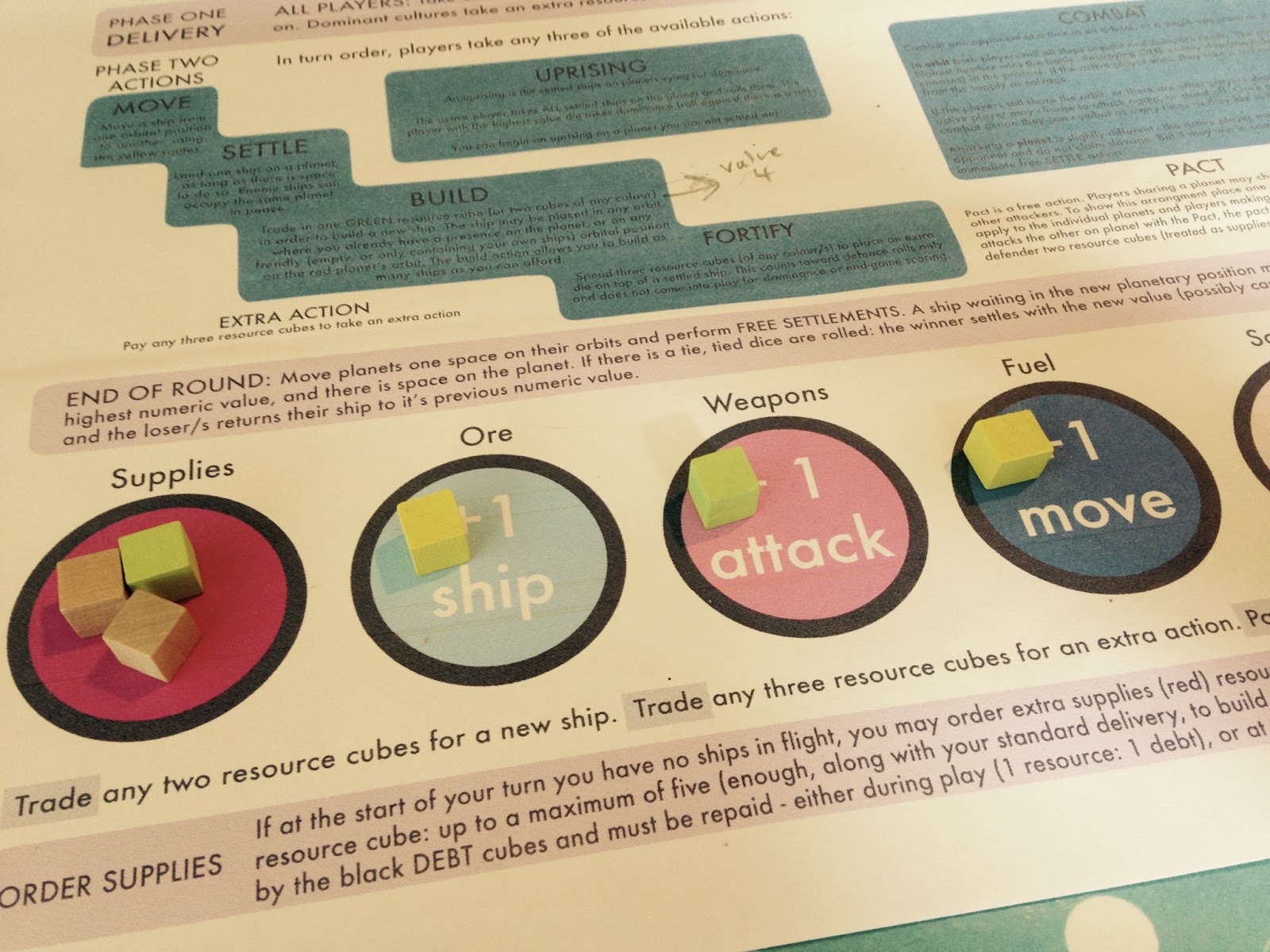
WIP player mats
The idea was to make a feisty game where players are encouraged to go all out attack (trying to get dominance in all planets) or consolidate by stockpiling resources. But of course, you can only stockpile cubes if you're picking them up in the first place...

Ian is dominant
We played nine rounds in a little over an hour. I'd fallen away dramatically and had taken on some debt in order to build more ships. Having done so, I sprang back into what I thought was contention - gaining dominance in two planets. But the very next turn Andrew got himself back on top in four of them. He then went for the fifth, knowing if he managed to roll a six, he'd grab the planet and mostly likely the game. He rolled a six!

late game: orange (me) is struggling whilst the other two battle it out
Andrew 31
Ian 23
Sam 12
Hard for me to be objective, especially when throughout I was worrying if it was too fiddly/too luck-based/too X. But I think I enjoyed it.
With that trial by fire out the way, Chris was yet to arrive, sending us a mysterious text about poop.
So we decided to give Madame Ching another go; the board game that's actually a card game. The game played very fast - only 30 minutes - and whilst no-one made it to Hong Kong or claimed the China Pearl, we did at least give the impression we knew what we were doing this time.
Andrew 25
Sam 22
Ian 21

those lovely clouds
As we were debating what to play next Chris arrived. Having cleared up the mystery of the poo text, and cleared up the source of the poo text as well, we went and stared at the games cupboard in huddled discussion. Five Tribes nearly got played, but in the end we went for one of Chris' favourites: Concordia. It's not been seen for a while at GNN and playing it I think that's because it is a rather staccato experience: often turns whizz by, but everyone had their moments of pausing, staring at their cards and the board, and then saying "shit". Games are so fun!
I went with my tried and not-totally-trusted method of spreading around the board and trying to nab Saturnus cards which reward you for settlements in different regions. I can't remember what Ian and Chris did, but I do remember looking over at Andrew's cards in final scoring and thinking "shit" - games, fun!

Andrew (black) doesn't look that threatening mid-game
Andrew 120
Sam 101
Chris 96
Ian 86
We then played Waggle Dance, the game of dice-rolling worker placement. Fool's Gold pulls this combo off really well, but Waggle Dance ...doesn't. It looks nice, it's easy to teach, there's a fair bit of screwage, but unless I imagined it, we were all largely underwhelmed. At least it's quick, though.

Waggle
Sam 4 honey (wins on tie-breaker)
Andrew 4 honey
Ian 3 honey (third on tie-breaker)
Chris 3 honey
There was just time for a blast of Push It before we wrapped up. This time it was Andrew who lagged behind the rest of us, only to make a belated push for glory. But someone - Chris I think - sent my disc ricocheting into the puck to give me a rather jammy two-disc win:
Sam 12
Ian 9
Chris 8
Andrew 5
Lots of fun. And thanks for indulging me on Orbital.
Saturday, 7 March 2015
The Reich Stuff
A brief two-player evening was arranged between Sam and I on Thursday. I arrived as he was packing away Lords of Waterdeep, ruefully telling me that his son, Stanley, had beaten him again.
First to the table was Small Print, Sam's own creation. Although meant for three or four players, but Sam wanted to give it a test run. It was okay, but with only two players, it was pretty easy to remember who played what. Also, very little chance of going bust. But Sam seemed happy that a few wrinkles had been highlighted, and what he should do next.
After this came Memoir 44. The tiny plastic soldiers were enough to bring back memories of playing as a child with miniature soldiers. But the game itself has nothing to do with trying to retake the sofa and footstool from the enemy. It's a fairly lightweight recreation of various military episodes from 1944. The game comes with a number if scenarios, each one of which should be played twice, with the players swapping sides after the first go.

Orders are given to your troops by playing cards, and battles are decided with dice. Towards the end of both games, I had a hand of cards which didn't let me give any orders to the troops I needed to move. I suppose there are finer details about hand management. Instead of just using the strongest card, I might have held some back. Sam seemed happier with it, but I'm not so sure. Cards and dice is a tricky combination, and I'm not convinced this game got it right. Maybe my cynicism is due to my sound 12-3 thrashing, though.

We then considered our next game. At first we considered 7 Wonders, but instead chose The Castles of Mad King Ludwig on the grounds that it was already out. We like this game so much we decided on a “long” game, with only ten room cards removed.
But now it was my turn to get lucky with cards. I got two bonus cards early on: 8 points for a castle with each room size and 7 points for a castle with each room type. In a normal game, these two would be very difficult. But with so many cards available, I felt confident. And, in fact, I did it. It was close though: only one 450 room came out and I had to nab it fast. Meanwhile, Sam did not get his bonuses working, and I came out a distant winner 152-116.
First to the table was Small Print, Sam's own creation. Although meant for three or four players, but Sam wanted to give it a test run. It was okay, but with only two players, it was pretty easy to remember who played what. Also, very little chance of going bust. But Sam seemed happy that a few wrinkles had been highlighted, and what he should do next.
After this came Memoir 44. The tiny plastic soldiers were enough to bring back memories of playing as a child with miniature soldiers. But the game itself has nothing to do with trying to retake the sofa and footstool from the enemy. It's a fairly lightweight recreation of various military episodes from 1944. The game comes with a number if scenarios, each one of which should be played twice, with the players swapping sides after the first go.
Orders are given to your troops by playing cards, and battles are decided with dice. Towards the end of both games, I had a hand of cards which didn't let me give any orders to the troops I needed to move. I suppose there are finer details about hand management. Instead of just using the strongest card, I might have held some back. Sam seemed happier with it, but I'm not so sure. Cards and dice is a tricky combination, and I'm not convinced this game got it right. Maybe my cynicism is due to my sound 12-3 thrashing, though.
We then considered our next game. At first we considered 7 Wonders, but instead chose The Castles of Mad King Ludwig on the grounds that it was already out. We like this game so much we decided on a “long” game, with only ten room cards removed.
But now it was my turn to get lucky with cards. I got two bonus cards early on: 8 points for a castle with each room size and 7 points for a castle with each room type. In a normal game, these two would be very difficult. But with so many cards available, I felt confident. And, in fact, I did it. It was close though: only one 450 room came out and I had to nab it fast. Meanwhile, Sam did not get his bonuses working, and I came out a distant winner 152-116.
Monday, 10 November 2014
Small Print
Long-time GNNers will recall having my embryonic game thoughts periodically thrust upon the table in the form of scribbled paper and basic photoshop skills, before I inevitably retreat with tail between my legs. THE TIME HAS COME AGAIN.
Let's be fair, it's been a couple of years. You've got off lightly.
I've been developing (i.e. thinking about) a game inspired partly by Raj and partly by High Society. Last night I play tested lengthily it with some like-minded folk (i.e. myself) and I think it's ready for a sortie out into the wider world of GNN. It only takes ten minutes to play (i.e. it won't waste as much of your time as Henchmen or Year of the Sheep).

It's a game of buying businesses and gaining the monetary value. Just like real life, you can do it straightforwardly, or operate with nefarious duplicitousness.
SET UP
Each player (2-4) is given a set of Paperwork cards: they are mostly Shares but they also have three Contract cards - Small, Big, and Total. The backs of the share and contract cards are identical. Players are also given wooden contract markers also labelled Small, Big and Total.
On the table there's a deck of Business cards that have a monetary value between £1m and £15m. These are shuffled and placed face-down.
PLAY
Play breaks down like this:
1. Reveal three business cards
2. Place paperwork cards face down (up to three per player)
3. Reveal paperwork cards.
4. Assign money.
Over a set of rounds (four for 2 or 4 players; three for 3 players) three of the Business cards are flipped face-up in a row, and players take turns placing a Paperwork card beneath them - face down. The cards will determine who gets what money from the business, and the Business cards have numbers on them to show how these divide between big and small contracts. Once everyone has played up to a maximum of three cards (or passed) the cards are flipped over and the business value is divvied up.
A Total contract will claim all of the business. Big and Small contracts will split the business according to the numerical values shown on the business card. And Share cards divide whatever is left over (or split/claim everything if no contracts were played).
But the contract cards under one business can be declared Illegal under certain circumstances.
A total contract and no other contracts is legal. Shares are ignored.
A big and small contract with no other contracts is legal. Shares are ignored.
One or two small contracts is legal. Any shares claim the remainder.
Any other combination of contracts will have over-valued the business and they are all declared null and void - the business is now split between share cards, if there are any. Share cards will also swoop up or divide anything left over from contracts that haven't claimed all the business. Any remainders after this divvying up go into a pool in the playing area labelled Small Print.
Also note: any business valued at over £10m splits the first £10m only between the contracts/shares; the rest goes into the small print pool.
There are also the Contract Markers. Players can choose to play these honestly, and put the marker on top of the corresponding contract card to announce to other players what they have played.
But they can also play any other marker, or no marker at all, or put a marker on a Share card (for instance, claiming to have played a Total contract to try and keep other players away). Markers are always returned to players after each round, though cards are not. So it's up to all players to try and remember who has used up what contract cards…
END OF A ROUND
At the end of the round any player who played a contract marker dishonestly has to take a penalty chit for each instance into their hand.
The business cards and any played contracts and shares are now discarded, and the next round begins with a new starting player.
END OF THE GAME
At the end of the game the player or players with the fewest penalty chits claims any money in the small print pool, and the player with the most cash wins.
Ties are decided on fewest penalty chits followed by most cards left in hand.
It's a celebration of rampant capitalism!

Let's be fair, it's been a couple of years. You've got off lightly.
I've been developing (i.e. thinking about) a game inspired partly by Raj and partly by High Society. Last night I play tested lengthily it with some like-minded folk (i.e. myself) and I think it's ready for a sortie out into the wider world of GNN. It only takes ten minutes to play (i.e. it won't waste as much of your time as Henchmen or Year of the Sheep).
the stuff
It's a game of buying businesses and gaining the monetary value. Just like real life, you can do it straightforwardly, or operate with nefarious duplicitousness.
SET UP
Each player (2-4) is given a set of Paperwork cards: they are mostly Shares but they also have three Contract cards - Small, Big, and Total. The backs of the share and contract cards are identical. Players are also given wooden contract markers also labelled Small, Big and Total.
On the table there's a deck of Business cards that have a monetary value between £1m and £15m. These are shuffled and placed face-down.
PLAY
Play breaks down like this:
1. Reveal three business cards
2. Place paperwork cards face down (up to three per player)
3. Reveal paperwork cards.
4. Assign money.
Over a set of rounds (four for 2 or 4 players; three for 3 players) three of the Business cards are flipped face-up in a row, and players take turns placing a Paperwork card beneath them - face down. The cards will determine who gets what money from the business, and the Business cards have numbers on them to show how these divide between big and small contracts. Once everyone has played up to a maximum of three cards (or passed) the cards are flipped over and the business value is divvied up.
A Total contract will claim all of the business. Big and Small contracts will split the business according to the numerical values shown on the business card. And Share cards divide whatever is left over (or split/claim everything if no contracts were played).
But the contract cards under one business can be declared Illegal under certain circumstances.
A total contract and no other contracts is legal. Shares are ignored.
A big and small contract with no other contracts is legal. Shares are ignored.
One or two small contracts is legal. Any shares claim the remainder.
Any other combination of contracts will have over-valued the business and they are all declared null and void - the business is now split between share cards, if there are any. Share cards will also swoop up or divide anything left over from contracts that haven't claimed all the business. Any remainders after this divvying up go into a pool in the playing area labelled Small Print.
Also note: any business valued at over £10m splits the first £10m only between the contracts/shares; the rest goes into the small print pool.
There are also the Contract Markers. Players can choose to play these honestly, and put the marker on top of the corresponding contract card to announce to other players what they have played.
But they can also play any other marker, or no marker at all, or put a marker on a Share card (for instance, claiming to have played a Total contract to try and keep other players away). Markers are always returned to players after each round, though cards are not. So it's up to all players to try and remember who has used up what contract cards…
END OF A ROUND
At the end of the round any player who played a contract marker dishonestly has to take a penalty chit for each instance into their hand.
The business cards and any played contracts and shares are now discarded, and the next round begins with a new starting player.
END OF THE GAME
At the end of the game the player or players with the fewest penalty chits claims any money in the small print pool, and the player with the most cash wins.
Ties are decided on fewest penalty chits followed by most cards left in hand.
It's a celebration of rampant capitalism!
What it doesn't look like yet
Tuesday, 14 August 2012
Return of the sheeples
Those lightweights at the Olympics may have packed up and gone home, but not us. Games Night is more important than a fortnight-long sports day with billions of spectators. At least, it is for us. Tonight my humble abode hosted a fully-fledged meeting for the first time, and it was the core four in attendance: myself, Sam, Joe and Adam.
We began in experimental mood as Sam's creation Year Of The Sheep got another playtest. With Joe's uncanny eye for detail, Sam made a lot of notes during the time we played. It also seemed as if your choices were made for you according to circumstances. No money? Then you have to protest so you don't have to pay rent. No food? Then you'd better harvest (or protest, if that card also gives you food). As such, there was little room for choosing different strategies.
Plus, the main point of the game – the cubes of the Black Watch clattering across the board colliding into your pieces – was still mostly absent: Too easily stopped by other protest cards. When it did occur, it was the most fun part of the game.
Due to the game's still unfinished state, this wasn't leaderboard, but for the record, I won.
Andrew 38
Adam 35
Joe/Sam 34
After an hour of this, we turned to more serious stuff... Magical Athlete! This racing game is dice based, but begins with a bidding round where you use your limited resources to put together a team of five characters, each with their own special power. Then five races are run, where everyone pits their characters against each other in a race across a shitty brown dirt track.
I enjoyed this, and was impressed by how close the races usually were. Everyone's special powers seemed to offer something different. Adam chose a very spoiling tactic, often choosing a character which would ruin other people's races. And, as such, he came in first.
Adam 14
Andrew/Joe 7
Sam 4
Next up was Biblios. A game so mysterious, it's very name can hypnotise Joe into repeating the title in a variety of emotions. Biblios? Biblios!! Oh... biblios...
It remains an enigma, but this time it seemed that people had a strategy of going after two colours. Whether this is the right strategy remains to be seen since everyone tried it, but only one person won.
Adam 7
Sam 6
Andrew 3
Joe 0
By now, we were on a roll! Maybe it was the smell of the new furniture that had addled our minds, but we kept on playing. Next up was Skull and Roses. A simple game of bluff and counter bluff, it was apparently once used to decide who would be next leader of Hell's Angels gangs. A story I personally doubt, but if it were true then Joe seriously chose the wrong path in life. He could be King of the Greasers by now. Or at the very least, friends with Lemmy from Motorhead.
1st Joe
2nd Adam
3rd Sam
4th Andrew
Was the night over yet? No!! We broke out Sam's brand new copy of No Thanks, to finish the night. For most of the start of this game, hardly any consecutive cards came out at all, and I think everyone picked up at least one card because they had to. But Adam ran into a run of lucky cards at the end. Not lucky enough to give him the first place all to himself, but lucky enough that he shouldn't complain after a good night's work.
Adam/Sam 41
Joe 48
Andrew 61
He leaps to the top of the form table by some margin.
We began in experimental mood as Sam's creation Year Of The Sheep got another playtest. With Joe's uncanny eye for detail, Sam made a lot of notes during the time we played. It also seemed as if your choices were made for you according to circumstances. No money? Then you have to protest so you don't have to pay rent. No food? Then you'd better harvest (or protest, if that card also gives you food). As such, there was little room for choosing different strategies.
Plus, the main point of the game – the cubes of the Black Watch clattering across the board colliding into your pieces – was still mostly absent: Too easily stopped by other protest cards. When it did occur, it was the most fun part of the game.
Due to the game's still unfinished state, this wasn't leaderboard, but for the record, I won.
Andrew 38
Adam 35
Joe/Sam 34
After an hour of this, we turned to more serious stuff... Magical Athlete! This racing game is dice based, but begins with a bidding round where you use your limited resources to put together a team of five characters, each with their own special power. Then five races are run, where everyone pits their characters against each other in a race across a shitty brown dirt track.
I enjoyed this, and was impressed by how close the races usually were. Everyone's special powers seemed to offer something different. Adam chose a very spoiling tactic, often choosing a character which would ruin other people's races. And, as such, he came in first.
Adam 14
Andrew/Joe 7
Sam 4
Next up was Biblios. A game so mysterious, it's very name can hypnotise Joe into repeating the title in a variety of emotions. Biblios? Biblios!! Oh... biblios...
It remains an enigma, but this time it seemed that people had a strategy of going after two colours. Whether this is the right strategy remains to be seen since everyone tried it, but only one person won.
Adam 7
Sam 6
Andrew 3
Joe 0
By now, we were on a roll! Maybe it was the smell of the new furniture that had addled our minds, but we kept on playing. Next up was Skull and Roses. A simple game of bluff and counter bluff, it was apparently once used to decide who would be next leader of Hell's Angels gangs. A story I personally doubt, but if it were true then Joe seriously chose the wrong path in life. He could be King of the Greasers by now. Or at the very least, friends with Lemmy from Motorhead.
1st Joe
2nd Adam
3rd Sam
4th Andrew
Was the night over yet? No!! We broke out Sam's brand new copy of No Thanks, to finish the night. For most of the start of this game, hardly any consecutive cards came out at all, and I think everyone picked up at least one card because they had to. But Adam ran into a run of lucky cards at the end. Not lucky enough to give him the first place all to himself, but lucky enough that he shouldn't complain after a good night's work.
Adam/Sam 41
Joe 48
Andrew 61
He leaps to the top of the form table by some margin.
| Points | ||||||
| Adam | 1 | 2 | 1 | 1 | 1 | 6 |
| Steve | 1 | 4 | 1 | 1 | 2 | 9 |
| Sam | 1 | 3 | 2 | 3 | 2 | 11 |
| Hannah | 3 | 4 | 1 | 2 | 1 | 11 |
| Joe | 3 | 1 | 4 | 2 | 4 | 14 |
| Anja | 4 | 2 | 3 | 2 | 2 | 13 |
| Andrew | 4 | 4 | 3 | 2 | 3 | 16 |
Wednesday, 1 August 2012
Night of the Sheep
As my fellow GNNers know, I have long harboured aspirations - okay, illusions - of inventing a game of my own that will stand up in the company of the Berger cupboard. Previous abortive efforts have included the somewhat fiddly Henchman and the more-promising-but-somehow-hollow Luddites. And of course I have been privileged to play the Paul Jefferies creation Cargo; although my recollections of it are hazy as I was unwittingly in the grip of appendicitis.
Anyway I haven't yet given up, and having still felt there was mileage in the destructive tower idea was behind Luddites, I changed my thinking to start with the theme first and then build on top of that. Wallace would be proud!
So the new game is The Year of the Sheep. This is not a game-based gag but a genuine 'year', for the game itself is based loosely on the Highland Clearances, when Clans were ejected from their ancestral homes to make way for profitable sheep-farming, generating cash for the aristocracy. It's an appalling chapter in Scottish history, and not one that can really be paid due respect by a game, but then as Joe pointed out when I was moaning about Age of Empires, lots of these games - combat or not - contain tons of implied tragedy.
In the game 2-4 players represent a clan that is fighting the incoming tide of sheep from Admiral Ross on the Isle of Skye. There are I guess elements of Agricola - worker placement, harvesting, feeding - along with the fire-fighting aspect of something like Year of the Dragon, as you strive to keep (and grow) your clan in the face of severe provocation. The game is broken down into three phases, and each player does all three in turn:
1 Growth: crops planted or cattle reared in previous rounds generate extra resource cubes.
2 Actions: Place your septs (workers; you begin with 2) on the spaces of your choice: sowing, harvesting, going to market, fishing, or protesting. The first two are self-explanatory and the market is obviously a way to turn your goods into cash or vice versa. Fishing basically buys you time - it's a way to feed your septs but it doesn't contribute to your success. And Protest does two things: Protesting means you don't pay rent for that round, and a protest card will also bring it's own benefits, detailed individually on the cards.
There are also some special actions that have limited access, but I won't go into too much detail here.
3 Feeding/Pay Rent. At the end of your turn you must feed your septs and an allotted amount of rent to Admiral Ross - unless of course you protested on your turn, in which case he can stick his rent.
However, after every third or fourth card (depending on how many players there are) in the Protest card deck a Clearance card will spring up; and that means the Admiral will send out the Black Watch to attack your crops and cattle - and possibly your village too - as they are placed precariously close to the castle in the centre of the board, from which the Watch will come hurtling almost as though dropped by a giant unseen hand through the castle roof. The Clearance cards also come with their own individual actions, which are not beneficial.
As the game progresses it gets harder to avoid the Black Watch, and halfway through the deck (when the Year of the Sheep card appears) they start replacing your crops with sheep, charging you more rent, and generally being a pain in the arse. When play ends - there are different ways to finish - players score points for their septs, buildings, fields, and money.
Final scores:
Andrew 86
Sam 77

I'm sure Andrew will give an honest appraisal but I thought it was a qualified success - or maybe a mitigated failure. I was really pleased with how the protesting system worked, and it felt like the cards and board(s) integrated very well. And the mechanics seemed to sit well with the theme.
But the things that need to be worked on were also very evident; namely that it was too easy for players to generate everything they needed (we both ended the game with bundles of cash), a few of the cards were a bit lopsided in terms of their effects, and in the latter stages of the game - mainly due to the aforementioned easiness - there was an element of treading water if we had plenty of septs to work with.
I did come away feeling there was some engineering to be done rather than a radical overhaul, and when I make those changes I hope you'll allow me to bring it to 'the table' in the GNN sense of the word. I mean, still a table, obviously. But a table with beer, ill-advised snacks, and the doughty intellect of the GNN group.
Anyway I haven't yet given up, and having still felt there was mileage in the destructive tower idea was behind Luddites, I changed my thinking to start with the theme first and then build on top of that. Wallace would be proud!
So the new game is The Year of the Sheep. This is not a game-based gag but a genuine 'year', for the game itself is based loosely on the Highland Clearances, when Clans were ejected from their ancestral homes to make way for profitable sheep-farming, generating cash for the aristocracy. It's an appalling chapter in Scottish history, and not one that can really be paid due respect by a game, but then as Joe pointed out when I was moaning about Age of Empires, lots of these games - combat or not - contain tons of implied tragedy.
In the game 2-4 players represent a clan that is fighting the incoming tide of sheep from Admiral Ross on the Isle of Skye. There are I guess elements of Agricola - worker placement, harvesting, feeding - along with the fire-fighting aspect of something like Year of the Dragon, as you strive to keep (and grow) your clan in the face of severe provocation. The game is broken down into three phases, and each player does all three in turn:
1 Growth: crops planted or cattle reared in previous rounds generate extra resource cubes.
2 Actions: Place your septs (workers; you begin with 2) on the spaces of your choice: sowing, harvesting, going to market, fishing, or protesting. The first two are self-explanatory and the market is obviously a way to turn your goods into cash or vice versa. Fishing basically buys you time - it's a way to feed your septs but it doesn't contribute to your success. And Protest does two things: Protesting means you don't pay rent for that round, and a protest card will also bring it's own benefits, detailed individually on the cards.
There are also some special actions that have limited access, but I won't go into too much detail here.
3 Feeding/Pay Rent. At the end of your turn you must feed your septs and an allotted amount of rent to Admiral Ross - unless of course you protested on your turn, in which case he can stick his rent.
*
However, after every third or fourth card (depending on how many players there are) in the Protest card deck a Clearance card will spring up; and that means the Admiral will send out the Black Watch to attack your crops and cattle - and possibly your village too - as they are placed precariously close to the castle in the centre of the board, from which the Watch will come hurtling almost as though dropped by a giant unseen hand through the castle roof. The Clearance cards also come with their own individual actions, which are not beneficial.
As the game progresses it gets harder to avoid the Black Watch, and halfway through the deck (when the Year of the Sheep card appears) they start replacing your crops with sheep, charging you more rent, and generally being a pain in the arse. When play ends - there are different ways to finish - players score points for their septs, buildings, fields, and money.
Final scores:
Andrew 86
Sam 77

*
I'm sure Andrew will give an honest appraisal but I thought it was a qualified success - or maybe a mitigated failure. I was really pleased with how the protesting system worked, and it felt like the cards and board(s) integrated very well. And the mechanics seemed to sit well with the theme.
But the things that need to be worked on were also very evident; namely that it was too easy for players to generate everything they needed (we both ended the game with bundles of cash), a few of the cards were a bit lopsided in terms of their effects, and in the latter stages of the game - mainly due to the aforementioned easiness - there was an element of treading water if we had plenty of septs to work with.
I did come away feeling there was some engineering to be done rather than a radical overhaul, and when I make those changes I hope you'll allow me to bring it to 'the table' in the GNN sense of the word. I mean, still a table, obviously. But a table with beer, ill-advised snacks, and the doughty intellect of the GNN group.
Wednesday, 23 May 2012
Because no car goes like a cargo goes
This week Paul made the long trek up the M4 (and other roads too) in order to join us, with his own creation Cargo! In his hands.


Five of us began the evening- me, Paul, Sam, Joe and Adam. We ooohed and ahhed as we unboxed Paul’s game, marvelling at the containers, the cards and the credits. Then Paul talked us through the rules, and we were off on a non-leaderboard adventure with heavy goods vehicles! We quickly decided that having plenty of lorries was a good idea, but then we got stung by road tax! Oh no! Also, different value cards were good, if you wanted to avoid the fate of Adam, who had two routes needing similar scores and could complete neither of them.
Andrew 45
Paul 44
Sam 40
Joe 19
Adam 15

At this point Sam gave in to his persistent illness and so Paul and I took him home, leaving Adam and Joe to play the game of Fit The Game Back In The Box. Once Paul and I returned, we perused Joe’s games cupboard and decided on Skulls and Roses and then Santiago as being new for Paul, and also easy to teach.
Skulls and Roses is like a simple version of Perudo, without all the clattering. We bet on whether we have skulls or roses on the underside of our beer mats. It’s a game of bluffing, which I’m very bad at. Paul, though, with his steely glare and poker face did very well, winning the requisite two rounds. Joe and Adam managed to win one each, while I was played for a fool, and didn’t win any at all.
1. Paul
2= Joe
2= Adam
3. Andrew
Santiago got another outing, again without the presence of Sam. We will play it one day when he’s here, honest. I tried to be as mean as possible when I was the Canal Overseer, and Adam seemed to go through the whole game with almost no money at all. Until the last round when I bribed him a lot to save one of my fields and lose one of his.
I bemoaned my fate of twice taking potato tiles, only for them to lose its only man or go arid that same go: “These potatoes have been a curse to me. You could say they’ve been a blight.” Oh, I’m hilarious. In the end, Adam took first place comfortably.
Adam 77
Andrew 67
Paul 58
Joe 54
Not much movement on the form table, except Anja edging upwards and Paul taking his place among us.


Five of us began the evening- me, Paul, Sam, Joe and Adam. We ooohed and ahhed as we unboxed Paul’s game, marvelling at the containers, the cards and the credits. Then Paul talked us through the rules, and we were off on a non-leaderboard adventure with heavy goods vehicles! We quickly decided that having plenty of lorries was a good idea, but then we got stung by road tax! Oh no! Also, different value cards were good, if you wanted to avoid the fate of Adam, who had two routes needing similar scores and could complete neither of them.
Andrew 45
Paul 44
Sam 40
Joe 19
Adam 15

At this point Sam gave in to his persistent illness and so Paul and I took him home, leaving Adam and Joe to play the game of Fit The Game Back In The Box. Once Paul and I returned, we perused Joe’s games cupboard and decided on Skulls and Roses and then Santiago as being new for Paul, and also easy to teach.
Skulls and Roses is like a simple version of Perudo, without all the clattering. We bet on whether we have skulls or roses on the underside of our beer mats. It’s a game of bluffing, which I’m very bad at. Paul, though, with his steely glare and poker face did very well, winning the requisite two rounds. Joe and Adam managed to win one each, while I was played for a fool, and didn’t win any at all.
1. Paul
2= Joe
2= Adam
3. Andrew
Santiago got another outing, again without the presence of Sam. We will play it one day when he’s here, honest. I tried to be as mean as possible when I was the Canal Overseer, and Adam seemed to go through the whole game with almost no money at all. Until the last round when I bribed him a lot to save one of my fields and lose one of his.
I bemoaned my fate of twice taking potato tiles, only for them to lose its only man or go arid that same go: “These potatoes have been a curse to me. You could say they’ve been a blight.” Oh, I’m hilarious. In the end, Adam took first place comfortably.
Adam 77
Andrew 67
Paul 58
Joe 54
Not much movement on the form table, except Anja edging upwards and Paul taking his place among us.
| Points | ||||||
| Steve | 1 | 1 | 2 | 2 | 1 | 7 |
| Adam | 1 | 2 | 3 | 2 | 4 | 12 |
| Anja | 2 | 2 | 5 | 2 | 2 | 13 |
| Sam | 3 | 2 | 3 | 3 | 2 | 13 |
| Hannah | 3 | 5 | 1 | 1 | 3 | 13 |
| Andrew | 2 | 3 | 5 | 3 | 1 | 14 |
| Joe | 4 | 2 | 4 | 1 | 5 | 16 |
| Quentin | 1 | 3 | 5 | 5 | 5 | 19 |
| Jonny | 2 | 2 | 5 | 5 | 5 | 19 |
| Paul | 3 | 1 | 5 | 5 | 5 | 19 |
| Sally | 3 | 5 | 5 | 5 | 5 | 23 |
Wednesday, 16 May 2012
Bracknell's new recruit
Bracknell's roving reporter reports...
Wow!
Last week went by in a blur. So much so I didn't have hardly any time to do anything let alone write up the games played, which was a shame because Cargo! was tabled for a second time. With rules refined and money/credits now printed out via the colour printer I gave Paul the game is starting to take shape. Depots are reduced to just the players home areas and now it costs to place containers into your opponents spaces and to take containers out. After my defeat last time I decided to beef up on lorries to maximise my route potential. This tactic and a few fortuitous card draws brought off my first win!
We also played 2 games of Roll Through the Ages and a quick game of Mummut all won be me but the real amazing moment of the week came today on my non game week. Driving back from Peppa Pig world with the family my wife Jacquie (confirmed board game disliker), announced that she quite fancied playing a board game this evening. After successfully not crashing into the central barrier I realised that this was probably one of those things people say on a whim like "I think I shall take up archery", and then as quickly as it popped in to their head it vanishes. However, after the bed time routine had come and gone and we had watched another episode of Breaking Bad, the question of a game came up again. I was concerned. This was an opportunity not to waste. Pick a game too nerdy and I could kiss any further requests goodbye. I chose Roll Through the ages as it is quick to learn and has a play time of around 30 minutes.
In a scene redolent of Blackadder teaching Baldrick advanced mathematics, statements such as "No look, it's quite simple" and "OK, don't worry about that" were aired numerous times and at one point the game was completely packed away, only to be unpacked again after brief discussion.
With Jacquie wearing a face like one reacting to the cat litter tray in the morning we proceeded. 20 minutes later Jacquie had proceeded to beat me by 15 points...I mean how does that even happen?
I got my revenge in the rematch but here's hoping to maybe another session one day...
Wow!
Last week went by in a blur. So much so I didn't have hardly any time to do anything let alone write up the games played, which was a shame because Cargo! was tabled for a second time. With rules refined and money/credits now printed out via the colour printer I gave Paul the game is starting to take shape. Depots are reduced to just the players home areas and now it costs to place containers into your opponents spaces and to take containers out. After my defeat last time I decided to beef up on lorries to maximise my route potential. This tactic and a few fortuitous card draws brought off my first win!
We also played 2 games of Roll Through the Ages and a quick game of Mummut all won be me but the real amazing moment of the week came today on my non game week. Driving back from Peppa Pig world with the family my wife Jacquie (confirmed board game disliker), announced that she quite fancied playing a board game this evening. After successfully not crashing into the central barrier I realised that this was probably one of those things people say on a whim like "I think I shall take up archery", and then as quickly as it popped in to their head it vanishes. However, after the bed time routine had come and gone and we had watched another episode of Breaking Bad, the question of a game came up again. I was concerned. This was an opportunity not to waste. Pick a game too nerdy and I could kiss any further requests goodbye. I chose Roll Through the ages as it is quick to learn and has a play time of around 30 minutes.
In a scene redolent of Blackadder teaching Baldrick advanced mathematics, statements such as "No look, it's quite simple" and "OK, don't worry about that" were aired numerous times and at one point the game was completely packed away, only to be unpacked again after brief discussion.
With Jacquie wearing a face like one reacting to the cat litter tray in the morning we proceeded. 20 minutes later Jacquie had proceeded to beat me by 15 points...I mean how does that even happen?
I got my revenge in the rematch but here's hoping to maybe another session one day...
Wednesday, 11 April 2012
I like Trucking and I like to Truck
So Paul finally made good on his long awaited promise of bringing his game to table this Tuesday. Previous weeks had been filled with intriguing comments like "Almost there", "Needs a few tweaks" and "I wish I had a colour printer" but now the teasing had stopped and I was presented with Cargo! (Intentional exclamation mark. See it as emphasis rather than surprise..).
So what is Cargo! you all chorus in prefect harmony. Well Cargo! is a game of freight transportation around Britain linking such nebulous hubs as Croydon, Bracknell and Eccles. Paul had cleverly spotted that lorries had been scandalously omitted from the games market and since trains had been done to death (And were quite expensive to buy) it was a natural theme to adopt (Plus Paul has a ton of beautifully crafted mini train containers). The central mechanic of the game is to create routes between the six depots via a route selected from your hand of cards to place next to your haulage companies lorries. The route cards have numbers at the bottom which in combination generate a number to be rolled (On two dice) to enable your cargo to be delivered. The depots hold all of the cargo and essentially you are removing one of a 20 or 40 foot container to be placed on your lorry complete with route to await delivery. When loads are delivered money is paid out for the size and type and where it was delivered.
Each player gets two actions per turn, whether that be buying or selling lorries, creating routes, obtaining cargo, rolling for delivery or replenishing your card hand. There are two scoring paths calculated at the games end. One is money you still have in your bank and the second is for route cards collected and totalled.
It didn't take us long to get into the swing of it and as with all home designed games getting it's first play, there were some rule changes on the fly. The most difficult bit to grasp, for both parties, was that due to limitations of the game components available to Paul, the container specific money colour didn't match the containers. Therefore we were constantly having to refer to the crib sheet for information.

Who is playing Cargo!? It's Paul!
Not that it detracted from a nice flowing game that saw me race up to 4 lorries in my fleet and amass a lovely pile of dosh. However, Paul had been able to make a lot more deliveries in the game in more locations and consequently scored more for his routes. There was a lovely moment when we had to decide who had won a particular route as Paul had one card for it but it was a minus 1, I didn't have any so technically a zero. Did having a minus number beat someone without a card? We decided the route wouldn't be scored as no cards meant no score and the minus cards were meant to be punitive. My money scoring couldn't quite make up the difference so Paul won the first play of his game…..
Paul 69
Chris 64
After the strenuous activity of delivering our loads I suggested we take on another new game, Mammut. After 10 minutes struggling with the rules and repeated glances at the clock it was put away again for another day and the more familiar Dominion was tabled. Even my desperate knocking beer all over the table couldn't prevent Paul from registering a comfy win.
Paul 50-odd
Chris 37
Monday, 31 October 2011
Henchman Hunches

I've been mulling it over and come up with some changes:
There are now just four types of Follower, clearly labelled with their type and value:
B (Bishop) - 6
K (Knight) - 5
C (courtier) - 4
S (sentinel) - 3
The followers no longer have a 'specialist area' where they score more (too fiddly I think) and I've scrapped the advisors. Each player starts with one Bishop, one Knight, two Courtiers and two Sentinels, and it'll be possible to generate extra followers during gameplay (the same Followers you start with will be available 'for purchase' - i.e. another Bishop, Knight, and two each of the less valuable pieces).
There are now SIX areas to put your followers in. The Keep, Chapel, Chambers, Cloister and Court all get you influence (ie victory) points, and there are points for finishing 1st/2nd/3rd in these places. Additionally the Court (no matter where you place) gives you the option of trading in money to raise additional followers. Paying for extra followers costs you twice their value PLUS the number of the current round - - so a Bishop costs 12+1 gold to recruit in round one, a Sentinel costs 6+6 in round six, etc.
So how do you generate money?
You raise money by placing followers in the sixth area, the Treasury, and the money they raise is equivalent to their value; so a Bishop in the treasury would get you 6 gold, a Knight would get you 5 gold and so on.
Apart from the Cloister, there are limits to how many followers can go in each area - Keep (10), Court (8), Chambers (6), Treasury and Chapel (4 each).
Placement remains almost as it was when we played; in player order, as many or as few followers as you want (into one area at a time) and you can return to areas you've already placed followers in to add more. EXCEPTIONS: You may only lay ONE FOLLOWER AT A TIME into the Treasury.
I hope this ups the ante in terms of encouraging people to get more followers - I know we played an abridged version last time but it felt like getting more followers didn't help much - with this new system I think if you don't get more followers you might find your early lead would be exactly that, and nothing more.
Oh, and there's a useable dungeon now. I'm returning to my original idea of Henchman cards sending opposition pieces to the dungeon for one round. (Again, this will encourage more followers). So when you play a Henchman card you send your opposing player's LOWEST-SCORING follower in that area to the dungeon.
Henchman cards are still played in turn order, but now they are played ONE AT A TIME - and you can pass. As before, you can play multiple Henchman cards to the same area, and use 2 Henchman cards for one area as a joker to be played into another. When all four players pass the Henchman round is over - so if you pass hoping to see what others do and they all pass too, you CANNOT lay Henchman cards. Mwah ha ha! - etc.
Finally - you can only pick up Henchman cards by playing a Follower into the Cloister. That's where they hang out, see? There'll still be a display of 4 cards face-up at the start of each round, and you can take from there OR the top card on the deck. And there won't be Henchman cards for the Treasury, so your Followers are safe in there!
Finally the King is still around, and he is worth +4 in court and +2 in any area - except the dungeon, where he cannot be placed, and the Treasury, where he will give the HIGHEST SCORING player an extra 3 Gold. If there is a tie for highest scoring player they get an extra 1 gold each. The starting player places the King but DOES NOT lay any followers - he must wait for his next turn.
I think that's it. This is what I'm mooting for the scoring areas (1st/2nd/3rd)
Cloister (unlimited placement): 6/3/1
Keep (max 10 Followers): 8/4/2
Chambers (max 6 Followers): 9/5/3
Court (max 8 Followers) 10/6/4
Chapel (max 4 Followers): 12/7/5
Ties for position share the points (rounded down).
Treasury: (max X Followers): Does not score.
(X: number of players.)
What I'm hoping is there'll be some levels of intrigue to it, and some different ways of winning that aren't just going after the Chapel every time. But only by playing will we truly know...
Wednesday, 19 October 2011
When your creations turn against you
Tonight, games night had a slightly different atmosphere. Instead of playing the latest game bought by Sam or Joe in a moment of weakness, we were play-testing Sam’s very own gaming creation, Henchman.
In this game, each player has to gain favour with the King by winning control of various parts of the castle. To do this, each player places his pieces in turn, but the pieces’ identity (and, thus, their scoring potential) is kept a secret until the end of that round. Then, once everyone’s pieces are identified, it’s possible for each player to send in their henchman (in the form of cards you have in your hand) to try and tip the balance in one area. A cross between Stone Age and El Grande, really. The King is dying (yet is still surprisingly mobile) and the winner gets to be the King’s heir!
Once we started, we soon ironed out any unfair, incomplete or unworkable rules in the first round so that the rest of the game ran pretty smoothly. Once I got into it, I started to enjoy it and I liked the idea of just sending a single weak piece into one area with the hope that your Henchmen can force a win. When I was starting player, I had the chance to place the King, so I put him in the Throne Room, hoping that the lure of maximum points would entice the other three players into a big fight while I scored points in the other areas. As it turned out, that didn’t happen and I was able to win it quite easily, giving me a healthy score for that round which carried me through to the end of the game.
Andrew 84
Adam 81
Jonny 62
Sam 45
Sam’s distant last place made him cry out “I’ve invented a game I’m shit at!” which means that he joins Dr Frankenstein (creator of his monster), Dr Faust (his deal with the Devil) and Simon Fuller (the Spice Girls) in creating something that quickly grew out of his control.
But I’m sure that with a little fine-tuning, there’s definitely a neat little game here. There is a dungeon area on the game board, but no real way to send pieces there. If you could do that, then it may add a little spice, as those in the lead get pegged back by those desperately floundering in fourth.
After this, Jonny left and the three of us decided to have a quick leaderboard game because, God knows, we don’t have enough points on there already. Sam and Adam chose Trans America and although I’m shockingly bad at this game, I agreed. For a while (ie, the first round) it looked like my fortunes may be changing as Adam kindly helped me link all five cities. But following that, the game fell back into a familiar pattern as I crashed out in two rounds (scoring eight and six points).
Sam 3
Adam 10
Andrew 14
Meanwhile, the leaderboard continues to reward those who have nothing better to do with their weekday evenings so for just one day, I've decided to order it according to points ratio.
The leaderboard...
In this game, each player has to gain favour with the King by winning control of various parts of the castle. To do this, each player places his pieces in turn, but the pieces’ identity (and, thus, their scoring potential) is kept a secret until the end of that round. Then, once everyone’s pieces are identified, it’s possible for each player to send in their henchman (in the form of cards you have in your hand) to try and tip the balance in one area. A cross between Stone Age and El Grande, really. The King is dying (yet is still surprisingly mobile) and the winner gets to be the King’s heir!
Once we started, we soon ironed out any unfair, incomplete or unworkable rules in the first round so that the rest of the game ran pretty smoothly. Once I got into it, I started to enjoy it and I liked the idea of just sending a single weak piece into one area with the hope that your Henchmen can force a win. When I was starting player, I had the chance to place the King, so I put him in the Throne Room, hoping that the lure of maximum points would entice the other three players into a big fight while I scored points in the other areas. As it turned out, that didn’t happen and I was able to win it quite easily, giving me a healthy score for that round which carried me through to the end of the game.
Andrew 84
Adam 81
Jonny 62
Sam 45
Sam’s distant last place made him cry out “I’ve invented a game I’m shit at!” which means that he joins Dr Frankenstein (creator of his monster), Dr Faust (his deal with the Devil) and Simon Fuller (the Spice Girls) in creating something that quickly grew out of his control.
But I’m sure that with a little fine-tuning, there’s definitely a neat little game here. There is a dungeon area on the game board, but no real way to send pieces there. If you could do that, then it may add a little spice, as those in the lead get pegged back by those desperately floundering in fourth.
After this, Jonny left and the three of us decided to have a quick leaderboard game because, God knows, we don’t have enough points on there already. Sam and Adam chose Trans America and although I’m shockingly bad at this game, I agreed. For a while (ie, the first round) it looked like my fortunes may be changing as Adam kindly helped me link all five cities. But following that, the game fell back into a familiar pattern as I crashed out in two rounds (scoring eight and six points).
Sam 3
Adam 10
Andrew 14
Meanwhile, the leaderboard continues to reward those who have nothing better to do with their weekday evenings so for just one day, I've decided to order it according to points ratio.
The leaderboard...
| Played | Points | Ratio | |
| Sam | 12 | 54.5 | 4.54 |
| Sally | 1 | 4.5 | 4.5 |
| Adam | 10 | 44.5 | 4.45 |
| Dan | 2 | 8 | 4 |
| Andrew | 12 | 41.5 | 3.46 |
| Joe | 5 | 16.5 | 3.3 |
| Jonny | 1 | 2.5 | 2.5 |
Wednesday, 15 June 2011
Did you say TIN MINING?
Had an idea for a game - specifically a game for gamers, who, like many of us I imagine, have been scorned/mocked/pitied for our interest. I could get all Michael Ryan about not being understood, but I thought hang on, maybe I can turn this emotional pain into hard cash?
So here's 'Did You Say Tin Mining?!', a game about games, for gamers.
Each player is on holiday for five nights (each night = a round) with their games-resistant families and friends, and their aim is to get as many people as possible around their table for a game to raise kudos (kudos being the currency of the game and the defining factor in winning after round five). At the start of each round the potential players are turned over - the skeptic, the credible, the artist, the entertainer, the child - and real players use up kudos points bidding for them. Children are the easiest to get to the table but score you the fewest points, and skeptics obviously the hardest/most valuable, as they will be scathing of the thought of playing a game with you when they could be watching Inspector Morse, or making a red pepper reduction.
The other obstacle in your path is the game you're offering - there are only as many games as there are (real) players, made up from four building blocks of design, theme, mechanic, and time - which again, are assembled at your own cost during each round. Putting together the poorly designed, nerdily themed, clunkily mechanised 3-hour marathon about philosophy that is Eureka Moments will be a very hard sell in terms of getting your family to sit down with you. Whereas the great-looking Detective! (case-solving dice-based twenty-minute game) will be an easier sell, but won't get you as many kudos points per player when you 'play' it. As ever, the game is about diversification and striking a balance - going all out for a coup de grace in family-games-conversion could win you the game, but it could just leave you with Open Derision - yourself, sitting at an empty table. Minus twenty kudos!
It's early days but I think there's something in it, don't you?
Hello?
Subscribe to:
Posts (Atom)