Showing posts with label Twilight Struggle. Show all posts

Sunday, 19 August 2018

Afternoon Struggle

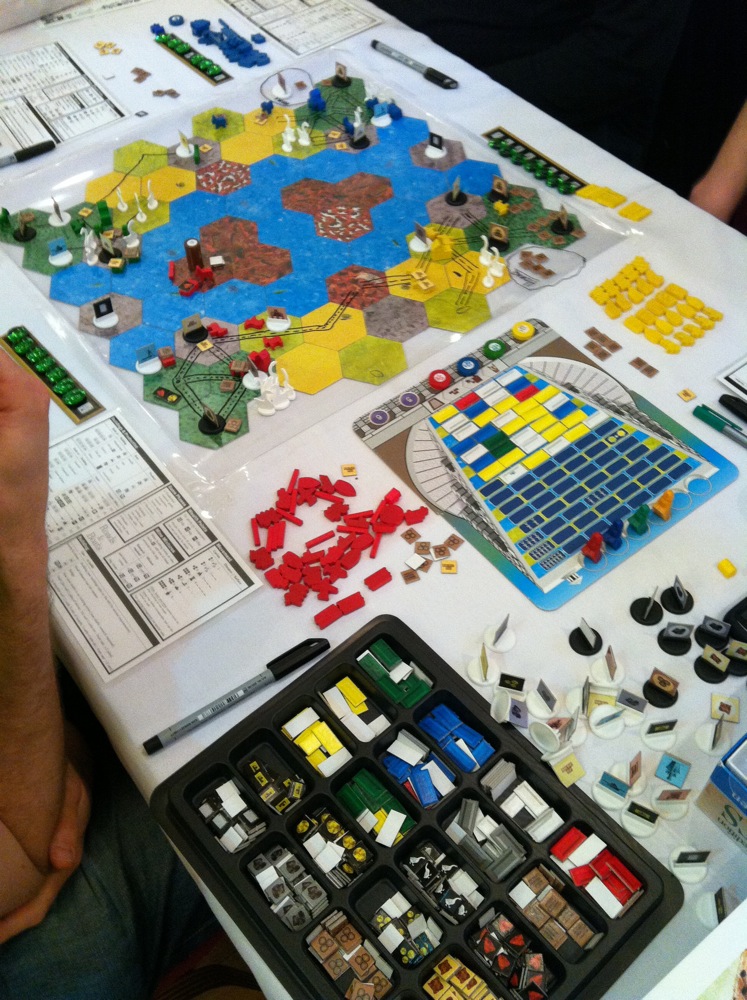
Stanley's intrigue with Twilight Struggle seemed to end at the high rating on BGG, as repeated threats to play it with me had morphed into a kind of bedtime-avoidance meme. I couldn't ask Sally - she'd once suggested that 'the twilight struggle' was what preceded 'the insertion of the twilight imperium'. Instead we all played Burgle Bros a couple of times (great game!)  before I set TS up again at Sally's folks house this afternoon.

Just like when Kevin Costner cut the grass in Field of Dreams, baseball players Stanley materialised, hypnotised by the chits, and played a couple of open hands before we graduated to standard hidden-cards play.


Stan was the US and I the USSR. Over forty-five years (or ten rounds) we play cards to grapple for influence and control of the political world. There's very little actual fighting - any open warfare has a cloaked feel to it, as one side or the other (possibly both) funds battles in climes far-flung from their home territories, for ostensibly unrelated reasons. In fact if you get too cantankerous and cause nuclear war - a danger tracked by the DEFCON status - you instantly lose.

So it's less melee, and more slippery political machinations. At the start of each round both sides play a 'headline' card, which is an event that - when played optimally - you hope swings the game, or at least a region, toward your control. Then players take turns with the rest of their cards playing them either as operations points (the number) or the event, with a crucial caveat - if you play a card for operations but it contains an event 'owned' by your opponent, it gets triggered anyway. Played events usually go from the game, whereas cards used for points will be reshuffled into the deck when it runs out.

All the events and operations are geared towards the same goals though - adding (or removing opponent's) influence from a country, or having enough influence there to turn it into outright control.

Some cards will score a region You can win by reaching 20 victory points, or having total control of Europe.

 Light side up is influence, colour-side up is control

My mini-playthrough last week (4 rounds) stood me in reasonable stead at the outset, as I focused my efforts in Europe and took an early lead. In fact Stan was convinced I was going to win, until I pointed out to him that my strong position wasn't enough for an outright win - but it would be a dramatic points swing. However when the Europe scoring card it came into Stan's hand, and I didn't realise that his chipping away in Europe was anything more than stubbornness. Suddenly Europe was scored and I realised that my near-total-control was nowhere near what it had been.

Meanwhile Stan had been spreading himself across the southern hemisphere and hot on the heels of Europe, he scored southeast Asia and catapulted himself up the score track.

I knew it was coming

As we entered mid-war, my stranglehold on Europe was deteriorating and Stan was sitting pretty on 11 points. I pushed into Central America and waited impatiently for Africa scoring. Stanley was developing his space flight technology, which acts as a kind of grease to the wheels of politicking, giving him little advantages on the map and triggering small points rewards. He also played Central America scoring which gave me a measly three points before I could do anything more exciting with it.

He was on the receiving end of some rough luck though when no less than three times a decent die roll could have given him victory, either by moving him up the space race track or winning a battle on the map. But when the end came in round eight, it was self-inflicted on my part as I gambled - despite my controlling more regions than Stan, he won the Summit battle and claimed a victory for the US.


Africa never arrived.

Both Joe and Martin really rate Twilight Struggle and I can see why. Compared to our COIN experience with Cuba Libre the play is very speedy and I would never have guessed how funny it is - Stan's cries of despair on his appalling dice rolls were matched by both us gnashing our teeth at having hands full of the other side's event cards. There's a slight lack of control (dice rolls, card hands) I found much more appealing than a heavy-thinking, zero-sum approach. That does mean fate can crap on you from a height at times, yes, but the game moved so fast we could forgive it that.

Stan gave it an "8.5, maybe 9" saying he liked how you're forced to change plans during the game. I'd agree! And be keen to play again.


Tuesday, 28 August 2012

Berger update part 2

Unbowed by our late-night Twilight Struggle, Henry and I continued our mini game-a-thon on Monday morning, while the rest of the household gradually woke and brunched. Henry wanted a TS rematched, but graciously agreed to test out Hammer of the Scots with me, a block war-game based on the Scottish rebellion of the 1290s.

I had bought it when we were in Scotland on holiday, and it's previous outing is detailed elsewhere in this blog (or perhaps in the comments). Having now played it, I can see it wasn't going to work for Charlotte, but it is an excellent game. Each sides pieces face the player in question, so whilst you might be able to see forces amassing, you can't be really sure of how strong they are until you engage in battle. We played the Braveheart scenario, which is 9 turns, Henry as the Scots and me as Edward I, trying to pin down Wallace and the rebelling nobles.
Despite our inexperience, it's a very smooth playing game, and the ebb and flow of fortune was fascinating - at one point it looked as though the Scots would overwhelm the English - a turn later and the tables were well and truly turned.

The winner is the one with the majority of nobles on his side at the end, and the English win a tie if Wallace is dead or off the board. Sure enough we tied, and I was convinced Henry had won. In fact it turned out Wallace, who I'd been desperately trying to root out all game, had been taken off the board during a wintering round, and was languishing face down in the pool (the pool of available pieces, but the analogy holds), giving me the win.Great game, would love to play again - I'll bring it along to Septcon in case anyone fancies a bit of 2 player kilt-waving.

We squeezed in a quick game of Mr Jack (Henry's first - he won as Jack!), and then laid down sour gaming tools in order to be sociable and cook some food. But once the meal was over and the kids happily ensconced in The Incredible Hulk, more games hit the table. The four of us played two games of 10 Days in Africa, which feels quite different to its European counterpart. Charlotte won one I think, and I won one.
During those games, Henry had begun discussing an unholy idea: a couples game of Twilight Struggle. And more incredibly, Charlotte had assented. If it all sounds a bit pampas grass/bowl of car keys, it did feel a little bit like we'd strayed into odd territory. Luckily I had enough remaining faculties to realise that it would be impossible to explain the game to our respective spouses whilst trying to play against each other, and that, more importantly, it wouldn't be nearly as much fun as Lords of Vegas.

So we played Lords of Vegas again. I had some early luck, and it looked as though I would run away with the game. Charlotte looked to be in particularly poor shape, still waiting for a single point when the rest of us had got to the 10 point mark. But the great thing about Vegas is the reversals of fortune, and as the game came to a close it was a three horse race between Charlotte, Henry and me. In the end, Charlotte raced ahead by 6 points, with Henry and I joint second again - this time Rachel trailing in las place.

By this time it was nearly 1am, but Henry was hardly going to let the game-a-thon end without a Twilight Struggle rematch, so we made cups of tea, took neurone to fight off the encroaching hangovers, and waded in. This time I was the US, and had learnt from Henry's experience of the night before. I knew I needed to hold of the USSR until well into the mid-war, and I managed to do it. By turn six it was clear we were in for the long haul, and called it a night.

This morning  we returned to the board, and embarked on round seven. I looked at my hand and saw that I had the Europe scoring card, which can win you the game if you control Europe when it is played. I only needed to shore up Poland and East Germany before playing the card and I would, for the first time, win the game as the US. But surely Henry would see my plans and stop me. Fortunately for me, he was holding the Asia scoring card, which not only took his mind off things closer to home, but crucially had to be played at some point rather than playing an ops card. This meant that even when he spotted my plan, I was able, with the help of a couple of lucky high value ops point cards, to keep the pressure on. Before the round was out, I had complete control of Europe and won the game.

We both regretted not pushing on last night, since it turned out we were so close to the end, though I was so exhausted I may well have misplayed my hand, allowing the game to drift on in to the later rounds. Twilight Struggle is epic, awesome and deceptively simple - very very deserving of it's sometime number one ranking on the Geek.

We just had time to play a quick game of Manouevre before Henry and Rachel returned to London - Henry's Prussians beating my Spanish by a whisker, just a card away from nightfall.

A lovely weekend of gaming, more than making up for missing out on saturday's Shogunnigans and regular GNN games night tonight - and a special commendation for Charlotte for being such a good sport, given her natural antipathy for the gentle art of cubes and cardboard. I couldn't ask for more! JB

Monday, 27 August 2012

Mini-update from the Bergers


Our friends Henry and Rachel are with us for the bank holiday, and as is traditional, games will be played. Henry and I played a fair few games of Twilight Struggle back at Easter, and Henry had texted his intention to "get some Twi-lit Strugggling in" before their arrival this time.

H & R and their three daughters got to us at five, and after we'd caught up properly (including a tour of the games cupboard) and eaten some food, it was nine o'clock. Undeterred, Cahrlotte was keen (yes, that's right - Charlotte - keen!) to introduce 10 Days in Europe. So we played a couple of games, which acted as the perfect warm-up to a main course of Lords of Vegas.
We had played a few games of Lords back at Easter, and it really worked for the four of us back then, but it was getting late; I was concerned about the length of the game, and suggested Skull & Roses. Cha poo-pooed the idea, and opted for the two hour game over the fifteen minute bluff-fest. Once again, you heard me right.

Rachel grabbed an early lead in Lords of Vegas, and the rest of us spent most of the game trying to catch her, without success. But it was fun trying - Henry's technique was to gamble vast amounts in Rachels casinos, the net result being handing her regular stipends of $20 million. Charlotte and I spent valuable money re-rolling the dice in casinos we had stakes in, but time and time again, the re-rolls came out exactly the same! In the end, Rach raced away with a win, Henry and I were tied for second-place, Charlotte close behind in third.
Lords of Vegas remains one of my all-time faves - I'm determined to try it on some non-gamers, I think it would be a great introduction to modern baordgames.

It was midnight now, and Charlotte and Rachel bowed out gracefully; since Henry rightly pointed out that it was too late to be learning rules, our only option seemed Twilight Struggle. Even I was a little daunted by the prospect, but we figured we'd set it up in the study, where it could remain undisturbed if we needed to pause for sleep.
In the end, my aggressive stance as USSR, coupled with some very lucky timing with Middle-East, Asia and finally Europe scoring cards, meant that the game was over by the end of turn three, with a decisive victory for the reds. We'd played for less than an hour!
Twilight Struggle often gets cited as a long game, but it only rruns long if no-one wins; if the players are inexperienced or out of practice, it can be over very quickly (usuaally with a victory for Russia - the US have to cling on until the late war, when the tide turns in their favour).

More games will doubtless be played today, and I'll provide another update this evening, just to show that I'm not slipping, despite my no-show at the recent GNN games-saturdays . . . JB

Monday, 9 April 2012

Welsh Rare Bits

For the first week of the Easter holidays, Charlotte, the girls and I went to Wales with old friends Rachel and Henry and their three daughters. Both R and H are keen gamers, and Charlotte will happily play a game in the evening, so while I was sure that Henry and I would find lots to get stuck into between days on the beach, long walks and cooking, I was interested to see which games would be hits and misses for the four of us.

We took a bevvy of two-player games, including Hansa, Manoeuvre, Commands and Colours: Ancients, and the big daddy, Twilight Struggle. The first game Henry and I broke out on arriving at the cottage near Pembroke was Manoeuvre. It's a game of Napoleonic-era battles, players assuming control of one of eight available armies, ranging from French, English, Ottoman all the way to the United States. Each army has eight units to go on the board, typically 6 infantry and 2 cavalry units, and a dedicated deck of small cards with which to battle and issue orders. The gameplay is simple; discard and draw cards, move one unit, attack with one unit.

A total rout by the French. Marvellous.

The typical attack by a single unit is very unlikely to eliminate its target, merely flip it to its weaker side, and next turn your opponent may well be able to restore it. So you really need to try and plan attacks so that you can add cards from your hand to strengthen the attack, possibly bringing in more units, leaders etc. The game plays in about 40 minutes once you know what you're doing, and is great fun. We tried out a few of the different arrmies - and each has it's innate strengths and weaknesses.

D6s, D8s and cartoon beer. Mmmm . . .

In the evenings, Charlotte and Rachel joined us. For the first couple of nights, the main event was a few rounds of Pickomino, which works brilliantly as a casual game with four - the perfect combination of push-your-luck, nicking each others tiles and not quite knowing who's winning until the final tally. It also allows for a lot of chatting in-between goes, which is certainly a plus as far as Charlotte is concerned.

Grubby dice. Unacceptable.

The first big game we all tried was Manila, which I got in the Euro Maths Trade the week before we went away. Though some of the mechanics (auction, worker-placement, a smattering of share-manipulation) are very familiar, it's nicely different from lots of the other games we play, definitely has its own niche, and plays in under an hour. It's essentially a game where you're playing the odds and betting on which boats will make it ashore and which will end up in the shipyard. It didn't quite catch fire for the four of us - though I can imagine it going down well with the GNN-ers.

We also played London, which is a favourite of Rachel and Henry's - it doesn't quite do it for me, and had a suspicion that it wouldn't be Charlotte's kind of game either, which turned out to be right. It's a game you really need to play a few times to get your head around and develop a strategy - there's simply no way a new player can hope to keep up, which can be dispiriting enough to put you off for good. I had played a couple of times with R & H before, and with Sam, enough to have a grasp of what to do, though that still put me in a distant third place. I can't quite put my finger on why it doesn't grab me; it's something to do with the complexity of the way city-size/boroughs/poverty/money formulae interact - it remains just a little too opaque for me to be enjoyable, though I can imagine getting into it as a 2 player over a few successive nights and finding it satisfying. I think it lacks the elusive 'fun' factor for me.

Another of our 2-player daytime staples was Hansa - a very stripped down Euro about trading in the Hanseatic League (not to be confused with recent GNN newbie Hansa Teutonica). In a way, it's similar to London in that the various components are symbiotically linked: money allows movement and buying of goods; goods allow placement of markets; markets allow conversion of goods into VPs, and get you more money. It's all wrapped up in a very pretty, refined package, and plays in about 20/30 mins. It can be played with four, but loses a lot of the strategy, I've heard.

Hansa by firelight.

As well as London, Henry had brought Ora et Labora with him, the latest big game by Uwe Rosenberg. Having bought it during last half-term, he and Rachel had not got round to playing it, despite a couple of attempts - on opening the box I could see why. If the number and variety of resources and playing boards weren't terrifying enough, the combined rulebooks, covering set-up, general rules, specifics and a multi-page glossary of buildings are positively fearsome. We decided not to attempt this with the women, at least not without a thorough playthrough between the two of us, and so we tackled it on a grey afternoon.
As it turns out, there was little to fear, and lots to enjoy. The rulebooks, if taken in the correct order, have you set up and playing within 20 minutes, and we found we could happily ignore at least half of them.
It is very much in the vein of Agricola, with players building up their monastery in either Ireland or France, felling forests, clearing peat bogs, brewing beer/making wine and gradually amassing victory points. It is apparently closer to Le Havre than Agricola, though graphically it definitely takes its cue from the earlier Rosenberg game. It took us a couple of hours to play, and at the end I was a little bit underwhelmed - it's very wide-open compared to Agricola, and consequently felt a bit flabby. In Agricola, you're operating at the bleeding-edge of subsistence, and every action counts. The world of O & L feels altogether more of a cornucopia, and whilst there are clearly strategic paths aplenty to amassing VPs in bulk, the fact that they are floating around from the very beginning and relatively easy to come by makes it feel less focussed. However, though we didn't manage to get it to the table again during the week, something about it has stayed with me; building your little cloister into a vast, all-encompassing monastery; brewing fine beer and distilling barrels of Irish Whisky, all wrapped-up in the cosy, inviting Agricola-esque hues. I want another go, and if any GNNers have their eye on a new game, I'll happily play it (not buying any more games, see?)

On wednesday evening, the four of us got to Lords of Vegas. I had my concerns, especially since the 'gambling' aspects of Manila had been a bit of a damp squib, and I couldn't remember quite how straightforward the mechanics of LoV were. As it turned out, it was a perfect fit - tense, exciting reversals-of-fortune, enthusiastic dice-rolling and a close finish with Rachel (I think) eeking a win against Henry. Henry particularly took to the risk-reward spirit of it, at one point betting $25 million on a single roll in Rachel's casino in a bid to scupper her plans. He lost.

Lords of Vegas: busy board, busy tablecloth.

We played again on thursday night, and it was even better, and closer, me edging in to first place on the final strip pay-out by virtue of my newly-acquired four tile casino. It was more coherent than when we played it at GNN, and I think we should give it another go. There are subtle strategies for staying in the game in the face of what seems like a runaway leader, which may have eluded us on the two outings we've given it.
On Friday night, we played Catan for old times sake, and R & H cleaned up, Rachel eventually squeaking the win from Henry, Charlotte and I languishing 3rd and fourth.

Ah, the familiar coastline of Catan. With an off-shore stockpile of cities.

Back on the two-player front, Henry and I had dabbled in a bit of Commands and Colours: Ancients, which felt a wee bit fiddly compared with the ultra-streamlined Manoeuvre, though with a more epic, majestic sweep, and probably a bit more depth. We'd also played a few games of Igloo Pop with the older daughters, and they played a few games of Alhambra and Mr Jack amongst themselves. We also played 6 player Shadow Hunters, though that was a bit unsatisfying - four of the six players won . . .

And in amongst it all, Henry and I found time to take on not one, not two, but three games of Twilight Struggle. We got to it a couple of days in to the holiday; Henry had hankering for a game since their last visit to us in September 2011, when I had just received it in a Maths Trade (we took one look at the rules back then and put it away). Since then I've only played it twice, so we were both eager to explore its intricacies.


In actual fact, we found it to be nowhere near as daunting as its reputation might suggest, especially since, on advice gleaned from Ryan Sturm's most recent How to Play, we all but ignored realignment rolls, further streamlining the learning curve. It is an awesome game, and we found that the game lasted longer, getting to later rounds without an outright winner, the more familiar we got with the cards and strategies. That said, Russia won all three games, though Henry, determined to break the Soviet stranglehold, put up a valiant fight in the last game (and enjoyed getting to prod me in the chest as he played the Kitchen Debates). And it's not stupidly long - all three of our games lasted between two and a half and three hours; though none lasted beyond turn six - an epic struggle that went the full ten rounds could last four, even five hours. In that sense it bucks the general trend, in that the better both players know the game, the longer it will take.

All in all an awesome week of gaming, perfectly intertwined with a very lovely week away, thanks to Henry and Rachel and their delightful girls. Roll on the new season of GNN, my loins are girded!
JB

Sunday, 8 January 2012

Five go mad in Stockport


Friday
Imagine unfolding a board game, and it doesn't stop. It covers the whole table, then the floor, then finally a whole conference hall of a medium sized hotel! This would not be dissimilar to Stabcon. Games which usually sit in a cupboard only to be allowed occasional visits to the kitchen table are suddenly given free reign to run around and do what they like. Now the players are not sat at the edge but are suddenly surrounded.

This environment seemed to affect some of the attendees. At Stabcon they were no longer geeks on the margins of society but were now in their element – they had status, walking around with all the confidence of a meeple who knows exactly what his next move will be. Some of them also dressed with confidence, albeit misplaced, with a wide selection of figure-hugging t-shirts, low-slung jeans and hats that were a couple of sizes too small for the wearer's head.

It was Steve's first Stabcon and as we pulled into the hotel car park, his first impressions can't have been good as the first identifiable gamer we saw was a guy with long greying hair and beard. Meanwhile, after only thirty seconds in the Stabcon hall, I heard someone cry out "Panic not!" and I wondered if it was going to be even geekier than last year. We signed in at the hotel, registered at Stabcon and grabbed a table.

Our first game was Wallenstein, a strategy game which involves moving coloured cubes around a map and in times of warfare, pouring the conflicting armies of small coloured cubes into a tower, hoping that yours will come out of the bottom while your enemy's cubes get stuck. It's a nice mechanic, and kind of random but not bad random, like dice. Plus, if you lost one battle, you could console yourself that your stuck cubes may be dislodged by your next battle, giving you an advantage.

We played quite happily, with a little help from a passing gamer who watched for a while and pointed out whenever we got a rule wrong. Joe also tried to count the number of women present since his wife was curious as to how many women turned up to these things. But on his first attempt, someone asked him what he was counting and he was too embarrassed to finish, and then on his second go he gave up saying "It's too difficult to tell!"

After Wallenstein (all results on the image at the end of the day's report), Joe suggested High Society. Reiner Knizia's cunning twist on bidding games. In this each player bids for cards numbered 1-10 or for a card that'll double your score. They also bid to not pick up bad cards such as –5, lose a card, or halve your score. The twist is that the person who has the least money remaining automatically loses, so there's no point in throwing your cash around like Mr Moneybags. It got a good response from me, but Steve admitted to not being sure what was going on. This was to become a recurring theme of the weekend.

We went to a nearby carvery for our dinner, just as we had done last year. They didn't remember us, though. Steve had the vegetarian option – a Wensleydale Bake which turned out to be mostly onions under it's thick layer of cheese.
rapt attendees
When we got back, we split up for a bit. Joe and Sam played another new game: Mr Jack. A cleverly devised game where one player has to guess which of the eight characters is Jack The Ripper, while the other player has to help Jack escape or evade detection. At the end of every round the detecting player asks if Jack is in the light or in the dark (ie, if he is next to a street light or next to another character then he is in the light) and thus the culprit is slowly revealed. There are eight rounds for Jack to escape/be caught. This is a very nice game and for once a proper detective board game. Although it's only for two players.

They then played Inka, which Joe wasn't too keen on, since there were simply too many variables to keep track of. Sam won this tile-sliding/rotating game too.

Meanwhile, me, Steve and Adam played Ascending Empires for some flicking fun. This Subbuteo in space got a few comments from people passing by who were interested in the game (and perhaps curious as to why Steve and Adam had large piles of victory points in front of them, whereas I seemed to have none). I was behind almost from the first flick, as Adam and Steve built up on techs. Eventually, I picked up three victory points after an exciting space battle with Steve. A battle which, according to Steve, cost him the game. Oopsie.

Then Area 51 regular Big Mike arrived asking if he could join a game. Joe and Sam were in the shop, and Adam, Steve and I were unsure what their plans were, but we agreed to a quick game of Tsuro. Easy to explain and fun to play and quick to finish – it was the perfect option. After we finished Big Mike seemed amazed that I was writing down the scores for future reference. "Live for the moment!" he exclaimed, which in any context other than a board games convention may have been life-affirming and exciting. As it was, he said it just before suggesting a game of Notre Dame.

After that there was a quick reshuffling of competitors. We chose Tinners' Trail but Big Mike was put off by the idea of a Martin Wallace game, so he went to teach Joe and Steve Priests of Ra.

Meanwhile, Sam, Adam and myself were joined by Simon (another Area 51 gamer) for his first ever tin-mining based game. He picked up the rules fairly quickly, and he kept up a commentary on his thought processes, perhaps hoping for us to jump in and offer a better option. Which we did... sometimes. Our game ended just before Joe and Steve's Priests of Ra, which they did not seem keen on. In fact, they walked out of the hall with all the relief of a half-drowned man crawling onto a river bank.

By now it was nearing one o'clock in the morning and so we ended our first day.


Saturday

Saturday is the day when most people attend Stabcon, and by the afternoon, every table was taken. At one point we left our table clear at lunch and lost it to another band of gamers. This relegated us to the wobbly table at the side. Nearest the bar, though, so not all bad.

But I'm getting ahead of myself. In the morning, after breakfast, we chose another new game, the eternally mispronounced La Cittá. I never really pressed people on the proper way to say it (Chi-TA, rhymes with pitta) and I'm glad I didn't because I doubt I'll ever hear it mentioned again. This game did not go down well, although we knew we weren't playing it in optimal circumstances: Five players, none of who had played it before.

This meant there was a lot of thinking in silence, and Adam quietly played Angry Birds on his phone between his goes. After a little under three hours, we decided to stop the game after the fourth round. Obviously the slow pace and unfamiliar rules can't have helped. I felt I had a fairly good grasp of it before too long, and perhaps as a three-player it'd be more interesting. Sam didn't seem keen on hanging onto it, so perhaps we'll never know. His quote, as we put it away, was a plaintive "Oh God, it's hideous!"

La Chitta (translation: 'the shitter')


After our lunch of sandwiches, Joe played Last Will with some other gamers, Sam and I played Mr Jack while Adam and Steve decided to tackle Twilight Struggle. I thoroughly enjoyed Mr Jack and I think it may be my favourite game of the weekend – short and simple, but very cunning. I lost both times, though.

Considering that Steve had already struggled with the rules of several games so far, I thought his choice to try and recreate the entire latter half of the twentieth century was a bold one. Especially against arch-tactician Adam. At one point I heard him ask Steve "Are you sure you don't want to invade Pakistan?" and I felt very grateful that he never joined the army or went into politics.

Despite Adam's warmongering, the game played out almost in real time and was abandoned after three hours, with no sign of Glasnost happening any time soon.

Meanwhile Sam and I chose a game of Alhambra. Perhaps he wanted to avenge his recent collapse in form. Dirk, once again, joined us and, once again, made the early running. But this time, Sam played a solid game, running out a clear winner.

Joe came back from his game of Last Will, declaring his affection for the game and the silliness of its theme. We played Ticket to Ride Switzerland – a map especially for three players. I really enjoyed this. It puts more emphasis on picking up more routes (which I did three times) which gives it an aspect of gambling, and the wild cards are only useful for tunnels. Of which there are a lot. Despite being the same game, TtR Switzerland has quite a different feel to the regular version. Meanwhile, Adam had got caught up in a short game with some other people, which he won.

Frequently during the weekend, between games, I'd wander around to see what other games where being played. I'd pause at each table to take in a little of the atmosphere and see if it looked interesting. At one table, I saw people sitting around a table without a board between them, and I wondered what game they were playing. It took me all of five seconds to work out that they were just chatting.

The five of us reconvened for a game of Joe's new game Mammut. Sam sat it out, happy to just watch. This game is a cleverly devised game of acceptable greed. Each game begins with a collection of Stone Age goodies (food, fire, animals, furs) from which each player may take as much as they like. But if they take too much, the next player is allowed to take their stash, returning one item to the centre. So each player needs to judge what is advantageous, but still doesn't look so great that someone else will take it. Added to this part of the game is a scoring system that confused Steve a bit, but we played on quite happily.

After our second visit to the carvery for dinner, we set up a game of Navegador on our wobbly table. Area 51 stalwart, Cuz walked past and said "I love this game. It's totally busted", meaning there's a sure-fire way to win the game. Since it was new to all five of us, it was slow going at first and Cuz's words hung heavily over the table. But as we got the hang of it, we started to enjoy it. I was black, and I was keen to recreate the historical arrival of the Black Ships from Portugal and their arrival in Nagasaki. But Steve beat me to it, and he was blue. Whoever heard of the Blue Ships from Portugal?!

By now, it was getting late. We played two games of High Society and then Sam and I called it a day at around half past eleven. But Joe, Steve and Adam weren't so easily satisfied. They hung on for one more game of Mammut.


Sunday

attendees playing Roads and Boats — a sunday Stabcon stalwart 

Me, Adam and Joe were the early risers and, after breakfast, we got ourselves a decent table. Steve arrived before long, and we discussed what to play while waiting for Sam. In the end we decided on Reiner Knizia's Decathlon because it's easy to learn and you can just stop when you want.

This game – a ten-event collection of dice games loosely themed on the events of a decathalon – was certainly easy to learn. Adam didn't like the lack of strategy, but it was certainly popular with other gamers. It was the only time in the whole weekend that we had spectators watching, Up to five people at one point.

Adam considered joining in with a game of Eclipse that was just setting up, and asked if any of us were interested. Eclipse was the top game of the convention, with as many as six games going on at the same time. It looked like an over-complicated monstrosity to me and the wide variety of plastic bits on the table didn't inspire confidence. Steve said he may try it next year if people are still playing it after all the hype had died down.

the ubiquitous Eclipse


Sam arrived, and we gave Navegador another try. As we played, I felt my gaming legs giving way. I was disadvantaged early and seemed unable to do anything about it. Two new tactics came into play, as Sam kept his boats near colonies allowing him to quickly claim them if anyone came close, while Adam sat on the advantageous Navegador card until it really helped him a lot.

Steve had trouble telling the difference between selling and processing goods, and I always wanted to do the action that I had just gone past. At the end, I thought Adam was the clear winner, but that turned out to be wrong! Sam won, with Joe in second. Then, as we were packing away, Joe realised he'd put a vital multiplier token on the wrong part of his playing board, costing him four points and first place!

Finally, we started to pack away and take things to the car, but there was time for two last games of Tsuro with a passing gamer from Sheffield. This was her first Stabcon but not her first gaming meeting, and we learnt that it wasn't very well publicised compared to the other board game conventions. After hearing this we wondered if we'd somehow stumbled upon a hardcore clique of gamers. And, if so, is it bad that we felt quite at home?

Sam and Joe finally got to chat with board game designer Martin Wallace, which must've been nice for them. As we drove away from Stockport, Joe surprised me by asking us if we thought Stabcon could last another day? I don't know about Stabcon, but I don't think I could have.


The final leaderboard puts Adam at the top of the pile for this year's visit to Stabcon! Congratulations.


GoldSilverBronze
Adam872
Sam834
Andrew383
Joe247
Steve144

Thursday, 17 November 2011

Cold War Classic

Whilst Sam and Andrew struggled cooperatively for control of Middle Earth (see below), Steve and I, down the road in Montpelier, went head to head with a struggle of a more modern kind.
Before Steve arrived, I had piled up a few choices, including Cuba, which we'd both played for the first time recently, and La Citta (another of The Works £7.99 wonders, one I haven't managed to play yet). I'd also included a couple of two-player games; Martin Wallace's A Few Acres of Snow, and BGG darling Twilight Struggle.
Having assessed the options we agreed that it would be wrong not to play a dedicated two-player game, given the circumstances, and I left it to Steve to make the choice. Acres would be a long rules learn, but a shorter game. Twilight Struggle (slightly) easier to grasp, much longer to play. Steve opted for Twilight Struggle.

The rules are a bit of a bear; it's not hugely complicated, but the direct conflict, zero-sum nature of the game means that you really need to be up to speed before going in. We started in on the rules description at 7.45, and an hour later we were setting up the first turn. I was USSR, Steve the free world.

The first turn took 45 mins, and was a fairly tentative affair -  there were no scoring cards - and we were just finding our feet. Turn two was very different, as I held the Middle East scoring, and Steve the Asia scoring; unfortunately for Steve, I had made some in-roads into Asia in turn one, so was able to concentrate on shoring up the Middle East to maximise my score there, and in the end, Asia was a dead heat, though I scored a few points for controlling battleground countries.

Turn two had taken a bit longer, and as we went in to turn three, the early war deck had to be re-shuffled, giving the potential for a repeat scoring of Middle East and/or Asia, along with the inevitable battle for Europe.
The whole of round three was a tug-of-war for Europe, and we were beginning to get a good feel for the game. It's daunting, of course, trying to take in the situation in every region at once. But what you realise through playing is that different regions become the focus of a round if someone holds a scorecard, which makes for a more managable cognitive load.

Steve managed to keep Europe out of my grasp, but hadn't managed to do the same in the Middle East, both of which scored in the final round of turn three. My Middle East victory pulled the VP marker all the way to my 20 VP goal, and the game was up. We were both glad in some ways, because it meant we'd completed a game rather than left it hanging (Steve confided he was going to call it a night at the end of the turn); but I was more glad than Steve.

I could really get into this game, if it got played more often - if time/tiredness were not factors, I think we would have both gone in again with a much more focussed, aggressive stance. It's well-deserving of its classic status; grown-up without being dry, competitive, but with enough luck from the cards to not feel too mean. The theme is perfectly in tune with the gameplay - I like the way the influence builds up in certain hot-spots; the more influence your opponent has, the more you need to have to try and wrest control, leading to mini-skyscrapers of chits in certain places.  All this, and the ever-present threat of nuclear armageddon - what more could you ask of a tuesday evening in november? JB

Wednesday, 19 October 2011

Do You Want To Play a Game?

Having missed out on the last THREE get-togethers, I thought I'd post up what little gaming I've managed to get done outside the GNN fold. Since last monday's impromptu game of Alhambra at mine, I've only managed to play one game. One third of a game, truth be told. But it was Twilight Struggle.

I had my mate Pascal staying on sunday and monday nights. He plays a lot of chess, and as a result is fairly skeptical about my obsession with 'modern games'. That is to say, he totally gets the obsession bit; the cardboard sniffing, the rules ingesting, the meeple fondling — him having had a long-standing thing about new pens — but he still needs convincing that they're actually worth playing.

I've slowly begun to win him over. Earlier in the year, he and his girlfriend Helen stayed and we introduced them to Settlers. I say 'we'; you all know about Charlotte's galeforce indifference to gaming — but she does like a bit of Settlers, and a bit of Alhambra too, in a casual, after-dinner sort of way. She draws the line at Stone Age.

Settlers went down well, as I thought it would. And more recently, Pascal and I have managed a game of Dominion, which he grasped quickly and enjoyed. A couple of traditional gateway games; one a tried and true classic, the other a very clever mechanic, together designed to illicit that face they do on cornflake adverts after taking the first mouthful — the pleasantly surprised 'I had no idea boardgames could be this much fun — I'm going to have to re-design my entire life so that it revolves around them' kind of face.

So this visit, I cast about for the obvious 'next step'. Alhambra? Stone Age? A five-hour card-driven chit-based war game about the Cold War?
Pasc doesn't need patronising — if he's going to get in to something, he wants to get as much of what it has to offer from the word go, really. Added to which, we have a shared love of espionage thrillers, steely movies like Le Samurai, The Ipcress Files, and much more recently Tinker, Tailor, Soldier, Spy; films that don't hide behind special-effects and chrome, but evoke a cool, dark world of international intrigue.

That all said, I hadn't played Twilight Struggle, which was, of course, the main reason behind my deciding it was the one we needed to play this time. And I wanted to show him that games could be grown-up; that they're not all trolls and zombies, or resource-management. Or zombie management.

Sunday night, I mentioned it, and showed him the box. On monday during the day, he brought the subject up a couple of times, but it wasn't until about 9.30 on monday evening, after sausages, cider and red wine, that we actually got the board out. 'Right, just tell me which are the snakes and which are the ladders', he wisecracked.

Despite being someone who actively dislikes learning rules, he absorbed them patiently, and by 10pm we were embarking on the first round. By midnight, we were finishing the second round, and I suggested we might pack it in. It had been a hugely steep learning curve, and while I was sure I'd want to try again sometime, I was suffering the effects of a vastly heavy cognitive load. And the Drambuie was out, too.
But Pasc, quite rightly really, wanted to push on — we'd only just got to grips with the rules, after all.
In the end we got to the end of round four, the first of the mid-war rounds. And his instinct to keep going was spot on, because the game really did click. Those last two rounds were much more aggressive, vying for influence in all seven regions of the board, and hatching longer term plans. I can see how deep it could get, once you know the cards, and the likelihood of scoring rounds in each stage of the game - pushing operations in South America to force your opponent to take his eye off the ball in the Middle East(to anyone who knows the game I'm going to sound like a total noob, I appreciate).

I think Pasc enjoyed it — I know he enjoyed having a tour of the upper-echelons of the hobby.
It would take a long, rainy sunday in the black mountains to really make the most of a game like Twilight Struggle. But for someone who confessed earlier in the evening to having fond memories of Cluedo, he certainly stepped up to the plate. And I have him to thank for finally getting TS to the table.

Oh and he won. As Russia. Well he didn't really win, because we only played four rounds, right?
And I was reading the rules for both of us. And it was beginners luck. Look let's just say he was in the lead when we abandoned the game.
JB