Scythe hasn't been out of the cupboard for a couple of weeks, so when Chris suggested it last night Andrew and I were amenable.
The box and components make this look a heavy game, but as we remarked approvingly last night, it plays very quickly. Each player represents a faction trying to become the dominant culture in an alternate Europe, but rather than just fight each other you're also trying to win over the local populace to your point of view - you might dominate the landscape, but if your opponents have made themselves more appealing to the locals, you won't win the game.
Each player starts with a faction board that has four 'slots' on it, with a top and bottom action. On your turn, you choose a slot and take either one or both of the available actions. The top actions: Move and Produce get you momentum on the board/resources from workers, Bolster improves your military might and Trade lets you pay money for resources. The bottom actions allow you to Build buildings, Enlist troops to your cause, Deploy a mech (which, unlike your production-minded workers, can fight for you) or Upgrade: making your top actions more profitable and your bottom actions cheaper to achieve.

So you're expanding on the map and aiming, at first, to stay out of each other's way whilst you try and improve the virtual cards in your hand. Like Eclipse, combat becomes a more common by-product - or even just a product - towards the end of the game, when winning or losing can be crucial. However, losing a fight is not as punitive as in Eclipse, and indeed winning one can make your popularity suffer. So whilst the game encourages some aggression, you need to choose your battles.
Stanley loves it and we'd recently played it three times on holiday, and once when his Warhammer-playing pal Theo came over (competitive dad won that one). I love it too - it plays far quicker than Eclipse and is much easier to explain to newbies. Like another favourite, Caverna, turns (usually) feel productive and there's room for Plans B and C. My only criticism is the fact players can magically ping around the board as a result of certain powers (and the mines) kind of breaks up the theme slightly. But then again, in Wallenstein combatants hurl themselves into a giant tower, and in Eclipse you can ignore some of the universe and throw it away... so I think we can handle that minor idiosyncrasy.


What I really like about Scythe is that there's a story to it - encounter tokens are liberally placed around the board at the start, and interacting with these allows you to make choices - they're always productive, but you can make them especially so and sacrifice your reputation (i.e. lose popularity!) or take the less alluring options and improve your reputation instead.
Several objectives allow you to place a Star to show you've achieved it - the moment any players places their sixth star, the game ends - although as I have found to my cost before, the player ending the game won't necessarily win it.
In the event, Chris found that knowing it slightly better worsened his game - possibly he thought too much? - as Andrew and I charged ahead. I focused on getting my buildings down and enlisting everyone I could - both give you ongoing bonuses for the rest of the game. My faction's special power was to take two options from the Encounter cards, so I travelled the board as far as I could maximising this - and inadvertently turding on Chris - twice - when I found myself stranded in his territory and had to fight my way out. I triggered the game end and took a solid win:
Sam 93
Andrew 62
Chris 23
With the time only 9.30pm, there was a multitude of options open to us. "Something that lasts half an hour!" Andrew said. "Forty-five minutes" Chris countered.
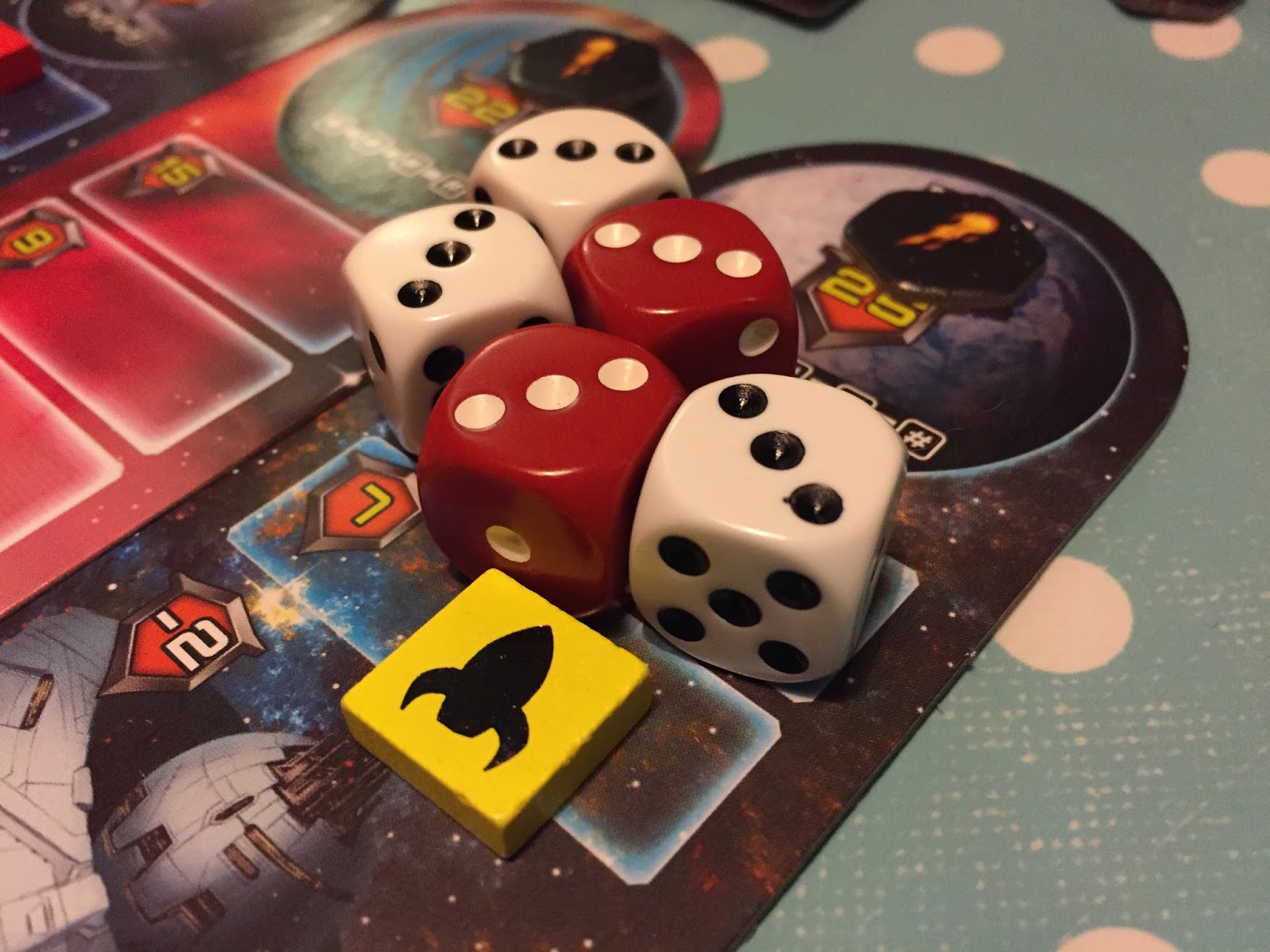
We played Cosmic Run. This is such a fun filler, but I'm starting to wonder if the recipe for success will always be the same. I ignored the alien cards early on and just pushed myself up the planet tracks; as we've found in the past, that seems to lead to the win - and so it was in this case.
Sam 69
Chris 42
Andrew 39
The alien cards are a lot of fun, but are they busted? Probably not, and this is just a random cluster of track-rewarding by fate. We'll see what happens next time.
Andrew called it a night and Chris and I had a quick run at Keltis: The Dice Game, the most challenging part of which - for me - was assembling the four-piece board, much to Chris' amusement. "It's double-sided!" I protested, with some (minor) justification. I got my revenge in the game itself when despite getting confused over which colour we were - in a two player game - I managed to nab the win by a few points.
Nice way to end the weekend, thanks chaps.
The box and components make this look a heavy game, but as we remarked approvingly last night, it plays very quickly. Each player represents a faction trying to become the dominant culture in an alternate Europe, but rather than just fight each other you're also trying to win over the local populace to your point of view - you might dominate the landscape, but if your opponents have made themselves more appealing to the locals, you won't win the game.
Each player starts with a faction board that has four 'slots' on it, with a top and bottom action. On your turn, you choose a slot and take either one or both of the available actions. The top actions: Move and Produce get you momentum on the board/resources from workers, Bolster improves your military might and Trade lets you pay money for resources. The bottom actions allow you to Build buildings, Enlist troops to your cause, Deploy a mech (which, unlike your production-minded workers, can fight for you) or Upgrade: making your top actions more profitable and your bottom actions cheaper to achieve.

Me
So you're expanding on the map and aiming, at first, to stay out of each other's way whilst you try and improve the virtual cards in your hand. Like Eclipse, combat becomes a more common by-product - or even just a product - towards the end of the game, when winning or losing can be crucial. However, losing a fight is not as punitive as in Eclipse, and indeed winning one can make your popularity suffer. So whilst the game encourages some aggression, you need to choose your battles.
Stanley loves it and we'd recently played it three times on holiday, and once when his Warhammer-playing pal Theo came over (competitive dad won that one). I love it too - it plays far quicker than Eclipse and is much easier to explain to newbies. Like another favourite, Caverna, turns (usually) feel productive and there's room for Plans B and C. My only criticism is the fact players can magically ping around the board as a result of certain powers (and the mines) kind of breaks up the theme slightly. But then again, in Wallenstein combatants hurl themselves into a giant tower, and in Eclipse you can ignore some of the universe and throw it away... so I think we can handle that minor idiosyncrasy.

Andrew having fun

Not sure what Chris is having
What I really like about Scythe is that there's a story to it - encounter tokens are liberally placed around the board at the start, and interacting with these allows you to make choices - they're always productive, but you can make them especially so and sacrifice your reputation (i.e. lose popularity!) or take the less alluring options and improve your reputation instead.
Several objectives allow you to place a Star to show you've achieved it - the moment any players places their sixth star, the game ends - although as I have found to my cost before, the player ending the game won't necessarily win it.
In the event, Chris found that knowing it slightly better worsened his game - possibly he thought too much? - as Andrew and I charged ahead. I focused on getting my buildings down and enlisting everyone I could - both give you ongoing bonuses for the rest of the game. My faction's special power was to take two options from the Encounter cards, so I travelled the board as far as I could maximising this - and inadvertently turding on Chris - twice - when I found myself stranded in his territory and had to fight my way out. I triggered the game end and took a solid win:
Sam 93
Andrew 62
Chris 23
With the time only 9.30pm, there was a multitude of options open to us. "Something that lasts half an hour!" Andrew said. "Forty-five minutes" Chris countered.
We played Cosmic Run. This is such a fun filler, but I'm starting to wonder if the recipe for success will always be the same. I ignored the alien cards early on and just pushed myself up the planet tracks; as we've found in the past, that seems to lead to the win - and so it was in this case.
Sam 69
Chris 42
Andrew 39
The alien cards are a lot of fun, but are they busted? Probably not, and this is just a random cluster of track-rewarding by fate. We'll see what happens next time.
Andrew called it a night and Chris and I had a quick run at Keltis: The Dice Game, the most challenging part of which - for me - was assembling the four-piece board, much to Chris' amusement. "It's double-sided!" I protested, with some (minor) justification. I got my revenge in the game itself when despite getting confused over which colour we were - in a two player game - I managed to nab the win by a few points.
Nice way to end the weekend, thanks chaps.