Sunday, 6 October 2019

Galactic Hurling

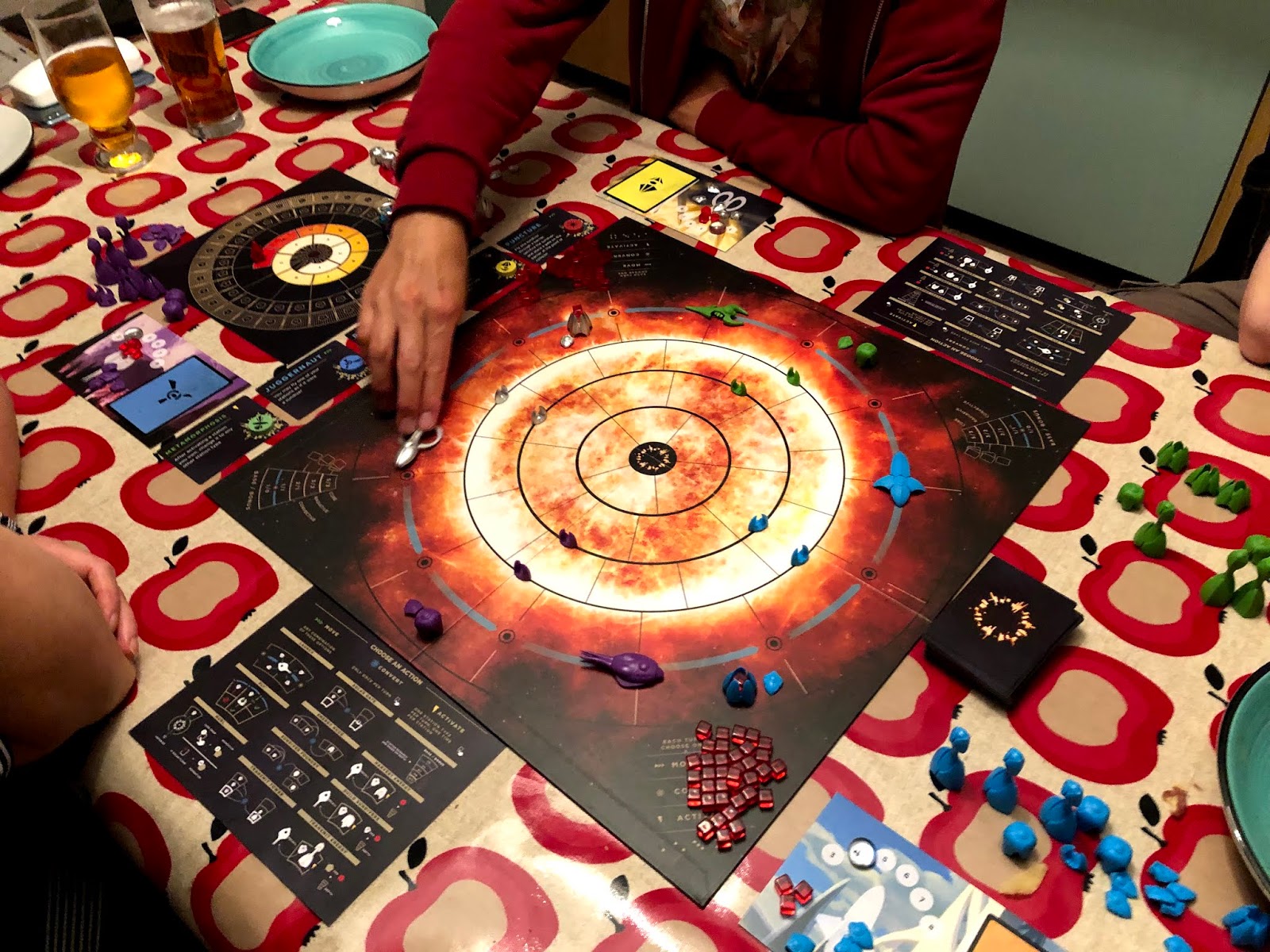
Saturday's gaming plans went through a series of last minute changes, with the alleged trio of Adam, Ian and myself (Sam) at my place losing the Creeping Custard to the creeping plague and relocating to Steve and Anja's, where we were briefly joined by a pyjama-ed Louie, before bedtime curfew was enforced. I'd brought Ancient Civilisations of the Inner Sea and was keen to revisit its brutal charms, but Steve was in the mood for something spacey, so we settled on the equally delightful Sol: Last Days of a Star.


I think most GNNers know the gist by now, but a brief recap: you're building three types of stations: to harness energy (Energy Nodes); convert energy into points (Transmit Towers); or use it building the Sundiver ships you need to carry out your orders (Foundries). Gates are also built to free up your movement around the board, and time will run out at some not-entirely unpredictable moment, when the 13th Solar Flare card is drawn...

I explained the rules to Steve and Anja, mostly, and we were off. The first few turns were cagey as always, as everyone gets their Sundivers into place in order to convert them into stations. I made an error on the rules, thinking that whenever you build anything you draw a card (-correct) and increase your movement capacity (-which you do for stations, but not gates). Anja was building a lot of gates, and when I realised my error and we corrected it, her movement depleted. Anja also suffered from circumstantial misfortune in that Steve, Ian and I found ourselves using each others gates quite a lot (which means free energy for the owner) whereas hers sat on their hinges for long periods.


Ian and I as the comparative old-timers in Sol, set the pace. I was first to build a Transmit Tower and kept getting bonuses as everyone used them. Ian built one too. Halfway through the deck we'd built a reasonably hefty lead over the newbies, at which point Anja's tactic changed, as she decided to hurl her ships into the sun to generate points (and card flips, accelerating the game). She had no hope of catching the leaders this way, but a separate battle was developing between the Dalton-Dales for third place.


As is Sol's wont, the leisurely beginnings were beginning to hurtle towards a dramatic conclusion as the deck-depletion sped up. I maintained enough of a lead over Ian to feel reasonably safe during the final throes of the star collapsing, but Steve's time ran out: Anja hurled one last sundiver into the celestial orb and drew the final solar flare, claiming third place just before Steve could score a chunky ten points!


Sam 37
Ian 24
Anja 16
Steve 13

A solar system down, we turned our focus to the more trivial business of building site worker safety in Men at Work. New to Anja, but easy to pick up and play, this competitive stacker sees you trying to be the least litigious constructor as you balance heavy girders on shoulders and send hard-hatted employees to hard-luck deaths, as Steve found to his cost


There are two ways to win: either by being the last one standing should all the other players cause one death too many, or by having a combined total of Most safety certificates and worker-of-the-month rosettes, which you get by placing the highest thing on the frankly bizarre construction site. Steve was in the lead late game courtesy of his tie-breaker (most rosettes) as Ian and Anja lagged behind both of us. But on Steve's final turn he made a crucial error and lost a safety certificate - handing me the win. Lots of fun; a shame Adam couldn't make it but lovely to catch up with the Dalton-Dales again! Sorry again about the gates rule, Anja 😯


Wednesday, 2 October 2019

Old Blue Eyes is Back!

An onslaught of spouse's birthdays, tiredness and general unavailability reduced our number to four last night: Katy, Martin and Ian came to my (Joe's) house, to pay our weekly tithes to the lords of gaming.


Speaking of lords, Katy was barely through the door before she suggested Lords of Vegas, and was met with a general murmur of approval. But Martin deftly produced Hats, and suggested we try out the 4 player team variant as an evening starter.

Martin read the blurb in a faintly terrifying manner (apparently Sam stopped him doing this mid-flow last week, and I can see why - very disturbing); something to do with the mad hatters tea-party, and nothing whatsoever to do with the gameplay, as far as I could see. Ian and I were new to the game, and we took Katy and Martin as our partners respectively. The team rules simply add that during your turn you can swap a card with your partner. On a first game it was quite perplexing to know what to swap or whether to bother at all, and despite the simple rules it's quite difficult to see the strategy as the round progresses.

Just look at trompe l'ouil effect of the cookie on the hanky. That's art!

In the end, both teams tied on 63 points, with the second tie-breaker going to Martin and me because I had the cookie. So I won!

Martin & Joe 63 (chocolate chippers)
Katy & Ian 63 (big dippers)

Certainly a game I'd like to try again.

 So Lords it was! Katy almost, but not quite, thought she might need a rules refresher, and we all laughed at the very idea. But as we were setting up, Martin quietly asked for player aid - perhaps it has been longer than we thought - Katy may not even have played since returning from her big trip, can that be right?

Martin got off to a swinging start, getting to 3 points before the rest of us had scored at all. I seemed to be completely devoted to back lots, and though I was able to build three casinos on my first turn, none of them paid out during the next round and I began my second turn with a paltry $2. But at least Frank was there for me - as I built what Martin described as a brothel (I think) on Frank Sinatra Way, he piped up quite unexpectedly on the stereo, hence the blog title.

Ian and Martin certainly did a lot of the early running, but as we entered the mid-game, Katy came storming back to own all three mega casinos on her side of the strip. Though they continued to fight shy of paying out, much to her chagrin, we could all see that they would eventually be the making of her. From then on, Martin and Katy tussled over ownership of a mega 8 point green casino, and the game was probably going to belong to whomever ran it when the final card came out. This made for some interesting offers of help - Ian and Katy bankrolled me reorganising the whole thing on my turn (I had a single die stake), much to Martin's horror. That worked out for Katy.

Note Katy's extremely neat card-stacking.

On a subsequent turn, spotting my plan to takeover Ian's casino, Martin offered to simply lend me $2 - vaguely adding that I might repay it with a hefty vig at some point in the future. It was an offer that felt in-keeping with the 50s Vegas theme, as there was undeniably an air of unspoken threat - I graciously declined the offer, not wanting to end up in a shallow grave in Red Rock West.

The game was also notable for Ian's poor book-keeping, which he blamed convincingly on the level of his beer glass. He inadvertently forgot to pay £24 million for the purchase of two casinos at one point; that's the demon drink for you.

When I drew the Game Over card, it was close for everyone but me. Katy and Martin tied, with the win going to Katy for more cash in hand. Martin was suitably enraged. Ian spotted that he would have won himself, had his takeover bid on the last turn succeeded. It was a game filled with highs, lows and stand up dice rolls (isn't it always?) - an unmitigated pleasure, even from the viewing angle of a distant fourth place.

Katy 44 (won on more cash-in-hand)
Martin 44
Ian 40
Joe 20

Half the board. I confess I was still more interested in Katy's ultra-neat card-arranging.

It was only 9.40, but it felt later - we decided on firm favourite Stinker as a warm down. I can't remember much about it, apart from being able to make the words marzipan and beetroot without using any stinkers in one round - if only it had been relevant to the prompt.

Not that we set much store by such things, but the final score after 8 rounds was close, and we'd each won two rounds. Except that Katy's second win was by judging her own to be the best (with our blessing - she was right).

Katy 27
Martin/Joe 25
Ian 23

After that, Katy and Ian made their farewells, and Martin convinced me that what I really needed was a whupping at 2-player Res Arcana. It wasn't too much of a rout, but I had mentally resigned the moment he began cranking out gold nuggets from his Dragon's Lair on turn one.

Martin 10
Joe 8

A fine evening, thanks all.

Sunday, 29 September 2019

Troy Tempest

On a day when the BBC put an article entitled “Board Games: why are they becoming so popular?” four GNN regulars met up for a first attempt at Ancient Civilisations of the Inner Sea. In the BBC video, not one of the reasons given was that people wanted to be dicks to each other while playing a game of indeterminate but considerable length. But that’s why we were sat around Sam’s kitchen table.

Ancient Civilisations of the Inner Sea is set at the dawn of the Bronze Age around the Mediterranean Sea as each player adopts the role of a local aspiring empire. In our game, Sam was Troy, Adam was Egypt, Ian was Carthage and I was Gaul. It superficially resembled Time Of Crisis and I swiftly expanded into Rome almost out of habit. Sadly it wasn’t a game-winning move.


Adam, though, sprang into an early lead, building cities and using cards to put him onto four points, to Sam’s three and Ian and I sharing one. (Or should that be sharing two, since we had one each?) Sam sent Civil War into Egypt, removing five of Adam’s discs. Adam just drank slowly from his beer while regarding Sam coldly.


Why are board games so popular? Hmm. Good question.

Soon after this point there was an event entitled Breath of God which saw everybody instantly discard their hands and draw four new cards. Cue a chorus of grumbles at the unfairness of it all. Ian seemed to make the most of the new opportunities as he built loads of cities: so many that our attempts at stopping him were largely fruitless. He picked up ten points that round, jumping into first.

He retained his estate of ten cities for a while until Adam played the Bread & Circuses card which meant that the player with the most cities had to lose that many VPs, or pay for them with money or cards from his hand. That knocked six points of his tally. Finally the first epoch ended and it was 9.30. We’d been playing for two and a half hours! A full game lasts four epochs.


Epoch Two began with a general agreement that this could be the last. But before too long another event, Time Marches On, brought the epoch to an abrupt end. The score at this point was Adam 34, Sam 34, Ian 31, Andrew 27.

Adam was the main target of our ire, as we set about dismantiling his Egyptian/Palestinian empire. But we always had an eye on each other, as I sent barbarians into Sam’s lands and tried to stop Ian’s expansion into southern Spain.


Being in last, I was mostly unhindered by my opponents but the game itself still managed to get in my way. The event Resistance To Chance cost me three points for most cities just as I was about to score big.

Then, wouldn’t you know it, Time Marches On made another appearance. Epoch Three came to a sudden end and, with that, so did the game. It was 10.50, so we didn’t feel like risking a fourth epoch.


Sam 42
Adam 41
Ian 40
Andrew 37

While it had been long, it had never been boring with a remarkable lack of downtime between turns. There’s always something to watch and something to react to. It was fun, but the fact that there’s no real way to guess how long a game will be makes it an “event” game rather than one that’ll make an appearance at the weekly meet. Ian also noted that the name itself - Ancient Civilisations on the Inner Sea - was slightly too long. Sam promised to bring it to Novocon.

Then Adam decided it was time to go, but was persuaded to stay for one more by the wall of rain outside. We played Yokai. It was a breeze after the hardships of ACIS. And we did very well, hitting Legendary on the score track thing.


And then we set off, into the rain. Thanks for the evening.

Wednesday, 25 September 2019

Wrong end of the sticht

This week witnessed the return of Katy, so that seven gaming stalwarts sat around Sam's kitchen table (Sam, Joe, Adam T, Martin, Ian, Katy and me). In fact, we began with eight, since Sam's son Joe joined us for a round of Fuji Flush.

It had been a while since we had last played it, but our biggest concern was not being able to talk about dick points in front of a child. A real shame since we began by all putting down 2s until Ian cleared the table with a 15. A big swinging dick, and we couldn't even mention it.

Adam 0
Joe M, Joe B, Martin 1
Ian, Andrew, Sam 2
Katy 3

Then Joe M requested a round of Insider, which we quickly cranked out. I was the master, and the word was Thermal Power Plant. During the guessing round, Katy, Sam and Joe B all suggested power plants, seemingly out of nothing, but despite that it was Ian who was the Insider. He'd won by using the old "quiet and mysterious" method.

Now we split into two groups. Three of us (Sam, Katy and Martin) played Hats. Not the album by The Blue Nile, but a set collecting game that comes with its own cookie. With it being so far away (again, I was perched at the end of the table) I know little about it. Not even what the cookie is for, but they played twice with Sam winning both games. I only noted the scores for the second, though.

Sam 29
Katy 28
Martin 26

We (Adam, Ian, Joe and me) chose Was Sticht?, a game whose box has been taken to several GNN nights but was rarely chosen. Until tonight. It's a trick taking game, but to describe it like that is like saying Kafka's Metamorphosis is about a man who just doesn't want to get out of bed.


Instead of dealing out the cards, they are distributed through a sort of mini game in which each player chooses a card from a column of a grid displaying all of the cards face up and then the "dealer" (who knows the trump suit) tells everyone who won among those four cards. In this way we are expected to deduce what the trump card is and adjust our choices accordingly.


Once that is done, each player has to chose one of the five targets they selected right at the start of the game, with criteria like No Tricks or Last Trick. If you complete this target then you discard it and the winner is the first to discard all five. Although, right from the start, we had agreed to play just four rounds. On top of all of this, lots of other rules kept cropping up during the game like someone who can't admit defeat in an argument and keeps coming back saying "and another thing..."

I found it all hard going at first, but by round four I think we'd all got the hang of it as we had gone from hesitant questioning to silent contemplation before our turns. This was certainly a good sign and I'd like to try it again soon.


Andrew 3 targets completed
Joe, Adam, Ian 2

Was Sticht took long enough that the other three squeezed in a game of Yokai and Eggs of Ostrich while we were in the final stages. In Yokai, Martin struggled to interpret his colleagues actions, saying to Sam that "I thought you were being clever," to which Sam bluntly replied "No." Nevertheless, they succeeded and were Glorious according to the scoresheet.


Then, in Eggs of Ostrich, Martin complained about how brutal it was. I think the score was

Martin 8
Sam 5
Katy 4

At this point, we were all available for mingling and, astonishingly, Toad in the Hole was offered up as a snack. This beat even Adam's offering of bite size sausage rolls at the start of the evening. The whole snack scene is seeing a revival that even Knizia would be jealous of.


Anyway, as for games, Adam, Ian and I chose Impulse while Sam, Joe, Martin and Katy played Senators, despite Katy's attempts at steering them towards Hit Z Road.

Senators was notable for Joe offering to buy olives in a creepy tone of voice. Katy seemed to enjoy her first game so maybe there's a chance of a revival?


Martin 9
Joe 8
Katy 6
Sam 5

During Impulse we started slow and with a remarkable lack of fighting coupled with a large amount of available Build actions meant that our space sector got pretty crowded.


Ian declared that he'd cocked up his techs and I was looking forward to a win when Adam snuck in and hit twenty points before I got a chance.

Adam 20
Andrew 14
Ian 11

While we finished Impulse, the other four amused themselves with a quick burst on Belratti. With Sam, Joe and Martin playing, some of the deductions about which painting belonged to which theme had an air of cryptic crossword to them. Sam tried to link Recycle to "re-sickle" until Joe told him that the drawing in question was a scythe. Martin tried to link Eye and Saw because it made "eyesore". Despite all this overthinking they did well, scoring 13-3.


Finally, we played Just One. This is a word game that I just don’t get. I keep expecting normal words but instead I get pop culture references or, as was tonight, an actual name. Despite clues to the moon landing and the other clue “Lance” I couldn’t get “Armstrong.” Sorry. Joe gave away the word by saying it out loud (Zeus) meaning a re-deal was necessary. Martin’s word was “passion” and when he saw our remaining clues: Desire, Throes and St Matthew, he said “Jesus Christ…” with an air of despair. At the mention of JC, I sort of chuckled and from that he was able to deduce the clue. Phew.


After this,we were finished. Thanks all, and hope to see you all again soon.

Ancient, but Not Necessarily Justified

The Mediterranean. A hotbed of civilisation squabbling, technological advancements and expansioneering. I could be describing ancient history, or any number of board games from the past 20 years, but it so happens this is Ancient Civilisations of the Inner Sea. That somewhat unwieldy title - and the box - makes it sound very dry and very heavy, but although ACIS is a wargame - a GMT wargame at that - the heaviest thing about it is your sighs when some Trojan mo'fo sends another batch of Barbarians your way.


The game plays up to six but is apparently best with four, for reasons of duration if nothing else. With four epochs to play through - each consisting of four turns, each turn a series of cards from every player - the game is long, although you can agree to play three or even just two epochs: plenty will happen in that time.

Everything occurs on a map. Depending on player count, some areas will be inaccessible, and yesterday that was half the board as I played the Trojans (green) against the Egyptians (purple). Set-up is simple: plonk some discs on your home turf: one disc is some nomads, two stacked are a settlement, three or four represent a city. Nomads from different civilisations can co-exist peacefully, but anything above a single disc in an area with your opponents also present triggers a competition.

But Competition is phase 3, and before that comes Growth Phase and Card Phase.

Growth is simple. For every settlement you have on the board and every set of two shallow seas you occupy, you get to add an extra disc to the board - either building up your existing presence or spreading out from it across the map. Each civ also has it's own little specialism that may come into play here: if Egypt has a city on the Nile, for instance, they gain additional discs and money (talents).

The Card Phase is simple too. But it's also brutal. Almost every card played has some kind of negative impact, some of them critical. Volcanoes for instant can obliterate the heart of a civilisation and The Breath of God (an Event: events are always played the instant they are revealed) screws everyone's plans up in a big way. To say it's swingy and chaotic is an understatement - it makes Battle for Rokugan seem like a gentle Euro. Four things help balance out the big hits however. One is the existence of Negate cards, that can cancel out another card's effect. Beware though - negate cards can be negated themselves, and a card used to negate a negate can itself be negated... and so on. And in a large deck of cards, they don't crop up as often as you might like.


Another is the Events, which often (not always!) give the player with the fewest points an opportunity to screw over the civilisation/s furthest ahead of them - usually by sending Barbarians their way. Third is the fact you can, instead of removing discs when instructed to by a shitty card, pay talents or discard cards instead - but this can be risky, as both can be helpful when we reach the competition phase later. The main thing though is the ebb and flow of power across the region - the classic get-the-leader of wargaming. This can happen not only from epoch to epoch and turn to turn, but even card to card. The ideal strategy is to somehow sit just behind the leader for the duration and never make yourself too much a target, but this isn't easy - when the leader takes a big hit (and they will!) you would be the new target.

Instead of playing a card on your turn, you can build one of the seven Wonders instead. These give your civilisation an ongoing benefit (unless someone buries them, to use the game's parlance) and also score you a point per round. But they are costly: you need to pay at least two discs from the map plus any three combinations of more discs/cards from hand/talents.

Investment cards are one of the few non-violent cards, 
functioning like mini-Wonders.

Once everyone has passed (you can play Negate cards after passing) the Competition phase arrives, which is the resolution of contested areas. There's no dice rolling: instead discs get removed in ascending order of stacks: first the nomads, then the settlements, then the three-stack cities, then the four-stack cities. This is repeated until there is either a single faction left, or only nomads. But of course you can - as you would in the card phase - choose to pay talents or discard cards instead. And some cards are specifically Competition cards that can help you out in a specific fight, or even all fights this turn.

If you manage to wipe out an opponent's city and gain/keep control of an area, you also get to Loot: taking a talent and a victory point to recognise and reward your wrath.


Finally there is Reckoning phase, where some discs may be removed if someone dominates areas of the sea (ie controls all adjacent land areas) everyone scores points for cities and unburied (and occupied) wonders, turn order is decided (most cities first) and new cards are drawn for the next round.

There are a few wrinkles - epoch scoring, sudden death step (the epoch may end suddenly!) and the possibility of a struggling player to explode the board somewhat by going rogue with the Aeneas Step during epochs 1, 2 or 3. If you're wiped off the map or at least 5points behind everyone else, you can invoke this rule (once per game) and give yourself something of a boost, introducing up to 16 new discs to the map either as your existing civilisation or a new one. It sounds a lot, but as you have 50 at your disposal in entirety, and most may be in play at this point, it's not actually a move you'd seek to use as a planned strategy.

Yesterday I played Troy (green) versus Egypt (purple), and Troy began strongly. Not only did they start well, they accelerated into a lead of over ten points. I was concerned at this point that Troy were simply drawing the more fortuitous cards, and once a lead was established it would - in a two player game, at least - simply be built on. However thanks to the Events Egypt was able to rally, as Barbarians attacked from the east and the north (and the less helpful south, but never mind) burying Troy's wonder and halting their advances south as Egypt counter-attacked. Troy's focus on expansion meant they had a huge presence on the board, but Egypt now had more cities and were scoring more points. The Egyptians raced in a strong lead and held it - with the downside being that they now bore the brunt of Events themselves. But owing to fortune, less events were appearing, and Troy had to change tactics. Once Egypt deployed heavily in the north-east corner of the map, Troy ceded the region and sailed south to the Nile, attacking Egypt's three cities and attempting to wipe out the Wonder there.

Endgame. Troy have decimated Egypt.

Egypt used most of its cards to defend the wonder and the city, in the end keeping the wonder intact but losing it as both sides fought over it for most of the final turn of the final epoch. In hindsight, Egypt might have been better to let that one go and attack Troy elsewhere - the vast spread of green settlements had been turned into cities, and in the final count-up Troy galloped over the line to claim a resurgent win, 60-58.

It's kinda nuts. BGG criticism essentially all says the same thing - that the game has no arc; that each civilisation has no opportunity to build infrastructure or the kind of advancements that allow for a more strategic overall approach. It is a reasonable observation, but my impression is this isn't an oversight: the designers have made ACIS very deliberately bunfighty and swingy, asking the players to police each other and the resultant pretty mess representing the ebb and flow of empires building and crumbling over the years. I would agree that kind of chaotic fight is probably better with a shorter game than ACIS's three-plus hours, but my game yesterday lasted two and I enjoyed every minute.


Sunday, 22 September 2019

One king to rule us all

If a blue moon can be defined as the second full moon in a calendar month, then this Saturday saw an even rarer phenomena: a blue Time of Crisis. We had met only a few weeks earlier but a sudden window in Martin’s schedule gave us a chance for a quick return. Too quick for Joe, however, and with Sam unable to stand in, Adam T stepped up to the plate. He had some experience with the base game, so it was only a matter of explaining the rules regarding the expansion before we were on our way.

We started the game with Martin in Gallia, Ian in Pannonia, me in Africa and Adam in Macedonia.

Just like last time, the first crisis roll sent a sassanid into Galatia. We chuckled at the curious coincidence. Little did we know that the sassanids were by no means finished with us. Anyway, things get convoluted early on, so I'm adding a little formatting to make things more readable.

Meanwhile Martin (3B 2R) took Hispania. Ian (3B 2R) rolled a new sassanid and took Thracia. I (2Y 3B) rolled a second Sassanid and took Syria and boosted its support. Adam rolled a third Sassanid and sent them all onto the board: two into Galatia and one more to Asia. He then took Egypt. “The Sassanids are winning,” observed Ian.


In round two, Martin (3Y 2R) hired a general and built a basilica in Hispania. Ian (3Y 3R) built and army in Thracia and a basilica in Pannonia. I (3Y 3R) built an army in Syria and a basilica in Africa. Adam (3R 3Y) built an a Limes in Egypt and a second army there. “Right,” said Martin, “that’s the set-up done with.”

So, round three went like this. Martin (3B 1R 2Y) took Britannia and put an army in there and boosted Gallia before buying a very important Foederati card. Ian (3B 2R) sent a goth into Galatia to join the three sassanids already there and then moved his army from Thracia into Asia to attack the lone sassanid there, but could only draw 0-0. Deprived of the chance of taking it over, he consoled himself by buying a 3 governor instead. I (3R 2Y) boosted support in Africa and then bought a governor. Adam (3B 2R) sent three Allamani into Ian’s Pannonia and then he reinforced his second army in Egypt. He also did something else I didn’t note. Bought a governor?

Anyway, round four began with Martin becoming Emperor. He (4B 3R 2Y) bought a new army in Gaul, feoderatied a Frank into it and them moved it into Italia. With his blue points, a basilica and an Ambitus card he had enough to become Emperor of a handsome four-province empire. We had to attack. Ian (3B 4Y) got himself voted into Martin’s Hispania. I had 3R and 3B so I sent my African army up to Britannia to attack him there, but lost. Still needing to weaken him, I tried to get voted in their too, but lost again. A poor move. Adam sent an Alammani into Thracia and then revealed his cards - 6R 2B. “I’ve gone a bit fighty,” he admitted. But he didn’t fight Martin, preferring to reinforce his 2nd Egyptian legion and sent it into Galatia, defeated the Goth there, tributed the sassanids and got himself voted in.


Martin 20, Adam 15, Ian 13, Andrew 11

In round five Emperor Martin found himself in a lucky situation. He had a weak hand (2R 2Y 1B) but thanks to the Sassanids making Galatia and Asia difficult to rule, the usual situation of having one or two rivals with three healthy regions didn’t apply here. In his turn, he got voted back into Hispania and boosted support and then reinforced his legion in Britannia. Ian triggered an event: Bad Augeries: A dire situation with his Pannonia full of Alammani. He reinforced his legion in Thracia and pluckily took on the three Alammani. He lost, 0-3, so had to boost support there. He then beat the lone alammani in Thracia. I (2B 2R 3Y) sent three sassanids into my own Syria and then got voted into Asia and boosted support there, and then reinforced my army in Syria, tributing the barbarians there. Adam (2Y 2B 2R) beat the sassanids in Galatia, 2-1.

Martin 29, Adam 23, Ian 19, Andrew 15

Martin noted he had been untouched in the previous round despite his weak hand. Ominously, he then said “Now I get the chance to be a bastard.” He (4R 5B 5Y) used a Demagogue to force us all to discard a card and if we chose to lose a level 1 card, he could hit us with a mob. In the end, only Adam did that, so a mob went into Macedonia. He then hired a governor, sent his army from HIspania into Egypt where it lost to Adam. He attacked me in Britannia but again those two armies drew. He then failed to get voted into my Asia, so he boosted support in Britannia and in an audacious move, a thematically accurate insult to the rest of us, he built a useless amphitheatre in Italia.


Ian (4R 2Y) sent a sassanid into Egypt. He took his Pannonian army into Gallia to kill of Martin’s remaining Militia there, and then boosted support in Pannonia. I ask for an event before I rolled my crisis roll and I got one! Bad Auguries was gone, much to my relief. Instead, Postumus joined us. A rival emperor who would hopefully stop Martin better than any of us were doing. My hand was 2R 3B 2Y which allowed me to foederati a Sassanid into my Syrian army, and then battled them. Thanks to my cavalry I won, despite only drawing 1-1. I then hired a new governor and boosted support in Asia. Adam (4B 4R) Foederatied a nomad into his Egyptian army and beat Martin 2-1. With no yellow points, Macedonia was bound to fall to the mob that Martin had put there, so he sent his Macedonian army across the map into Hispania and got voted in there instead.

Martin 37, Adam 32, Ian 24, Andrew 24

Round seven began with Martin (7R 2Y 3B) in an unassailable position. He was voted into neutral Macedonia and my Asia to boost his support in Rome to five! He built a new army in Gallia and Feoderatied a Frank into it, and then killed Postumus with a spiculum. Finally he built an army in Macedonia. Ian (3B 4Y) was voted back into Gallia and boosted support there, and also boosted support in Pannonia which was still troubled by Alammani. I (2R 4B) should have gone after Martin somehow but by this time it would have only hurt myself. So instead I turned against my nearest rival and got myself voted into Ian’s Pannonia and tributed the barbarians there. And I built an army in Africa. Adam (1R 6Y) boosted Egypt and Hispania, put a militia in Egypt and sent a mob into Martin’s Macedonia. Finally, he killed the Sassanids in Egypt.

Martin 54 Adam 40 Andrew 29 Ian 28

Round eight and obviously the final round saw Martin play another weak hand (2R 2Y 1B) but by then it barely mattered. He sent more barbarians onto the board, though: 3 Franks into my Pannonia and one kept going into Italia. Martin killed that Frank, and then dispersed the mob in Macedonia. He drew against my wounded legion in Britannia as we both rolled ones. He passed sixty points and the game end was triggered.


Ian (1Y 6R) sent the Priest King into Syria with his crisis roll and then he reinforced his army in Gallia, sent it into Pannonia to attack the Franks. He lost 2-3. His Asian army attacked the sassanids and at least killed them. I (1B 3Y 3R) rolled Good Auguries for my event, which was nice. I killed the Priest King, win a battle in Egypt (only displacing Adam’s army, not wiping them out) but then I failed to get voted in there. I boosted Pannonia, just to hang onto it for one last round. Adam sent sassanids into Galatia and Asia again, meaning they pretty much ended as they began. Meanwhile he (2R 4B) Fought and beat the Sassanids in Galatia, although thanks to Ian suddenly rolling high numbers, they did a lot of damage as they died. Then he fought my wounded legion in Egypt - a 0-0 draw and I must say I was grateful for the points I gained this game by drawing battles with wounded legions. A new strategy perhaps? Finally Adam was voted into Gallia.

The score track of Emperor turns.

Martin 74, Adam 51, Andrew 40, Ian 33

We were finished in barely two hours. Ian was disconsolate, believing it to be his lowest ever score (I checked - it was). I was keen to set off early to try and beat the crowds of a nearby festival that was happening this evening. Ian came along with me, leaving Adam and Martin to play out the evening with some two-player options. Sorry to dash, but the traffic was already appalling and I think we made the right choice. Thanks for hosting, Martin and thanks for the beef jerky.

Wednesday, 18 September 2019

No shreddies

This week, five fifths of our most regular players arrived at Joe's house for our weekly battle of wits and cunning. The missing one sixth was Katy, but she had recently impressed us all with an email showing her playing Isle Of Skye while actually on the Isle Of Skye.

Meanwhile, we happy five (Joe, Ian, Martin, Sam and me) began with a new game called Irish Gauge that had quickly convinced us with its pretty illustrations and promise of a rule book with only two pages.

Thematically correct alcohol!

Since it was a hex based train game, I was more than keen to give it a shot, but slowly it dawned upon us that something was missing. Martin wondered if we were playing it wrong, not in terms of rules but in terms of strategy. And he had a point: we were approaching it in a very Railways Of The World manner, building up our networks and getting everything in place before triggering a scoring round. Should we have been quicker to get dividends, or more generous with our bids for shares?

Who knows. In this game, Sam wrestled for an almost exclusive ownership of the blue network, but it cost him dearly. Martin kept sole control of his network of orange, possibly because it was the worst on the board. Joe, though, was rolling in money. His yellow network paid out well and he bought an early share into my purple network, and seemed to do very well out of that too. His regretful sigh of "I don't think I understand share games," was met with little sympathy since he was the clear leader at the time.


Joe 133
Martin 111
Andrew 110
Sam 84
Ian 80

We ended with a feeling of disappointment, and we were unable to tell if it was us or the game that was at fault. Lots of mumbling about needing to give it one more try.

We followed this with a rousing game of Stinker. Three whole rounds! I made more notes this time and, assuming that the random nature of the game somehow gives it oujia board type abilities to see the future, I can safely say that...

A cure for insomnia is... Oddbins sale (Ian)
The app missing from your smartphone is... Nob Measurer (Joe).
A greeting you don't want your robot to give you is... Hi pedo (Martin)
The next big thing is... Slappy Bags (Sam)
Your mama is... A real hottie (Joe)
And the eventual undoing of man will be... Christmas Toffee (me)


Ian 53
Martin 28
Sam 25
Joe 22
Andrew 21

After this giddy encounter with over excitement, we kept up the pressure with Voodoo Prince. Ian started badly, winning a hand with a five, effectively giving him two tricks (remember, three tricks in a round and you're out) but he hung on long enough to pick up a decent score that round.


Then, in round two of three, Ian was then second to last to pick up his third trick, giving him maximum points. He was, by now, the man to beat. "We need to fuck Ian up," said Martin while yawning, sounding like a decadent dictator idly requesting the assassination of an enemy.

But it was all for naught. Ian got maximum points in round three as well.

Ian 31
Martin 21
Sam 19
Andrew 18
Joe 14

Next up was Zero Down, a game that simply eludes me. I assume there's a strategy, but I am entirely unaware of what it is. Joe, however, has a better grasp of the matter.

Apart from Joe's serene stroll to victory, the rest of us spent our time cursing the player who'd just picked up the card we needed.


Joe 5
Ian 13
Sam 24
Andrew 34
Martin 46

During this game, someone described their luck as being a car crash which we misheard (for comedy purposes) as "cock rash."

And also, between games, Joe informed us of some adverts he'd seen for a new product: fart filtering pants. The testimonials from apparently happy users made it very difficult for us to tell if the product was genuine or not. But these adverts gave rise to the phrase "no shreddies" which now adorns this blog post.

Ian left after Zero Down, but we remaining four had one more game in us: Memoarrr. It is a simple memory game that demonstrates with such clarity your lack of short term memory that you may start to suspect oncoming dementia.


It's so simple, 25 cards, in an array of 5 by 5 with one removed (the scoring cards go in its space) and all you have to do is remember what is where. And you have seven rounds to do it! Couldn't be simpler, but I struggled massively. Great fun and I was slightly amazed how quickly my memory vanished once the cards had all been turned face down again.

But it was great fun, despite my complete inability to get anywhere with it.

One round went all the way until the end... Didn't help me, though

Joe 6
Sam 5
Martin 4
Andrew 0

And with that, we were done. Time for us all to stumble home, full of the thrill of battle and alcohol.